

The Substack Solopreneur Business Model
The Proven Blueprint of Creating Substack Ecosystem

Most people sign up for Substack to write.
That is the wrong reason.
Writing is the vehicle. A business is the destination. And the people who understand Substack deeply, not as a newsletter tool but as a complete business operating system, are quietly building six-figure one-person empires while everyone else is just publishing posts and wondering why nothing moves.
I was in the second group for a long time.
Then I stopped treating features like optional extras and started treating them like business infrastructure. Everything changed.
By the end of this, you will have a clear, step-by-step map that takes you from complete beginner to functioning solopreneur. All inside Substack. All using tools most people ignore.
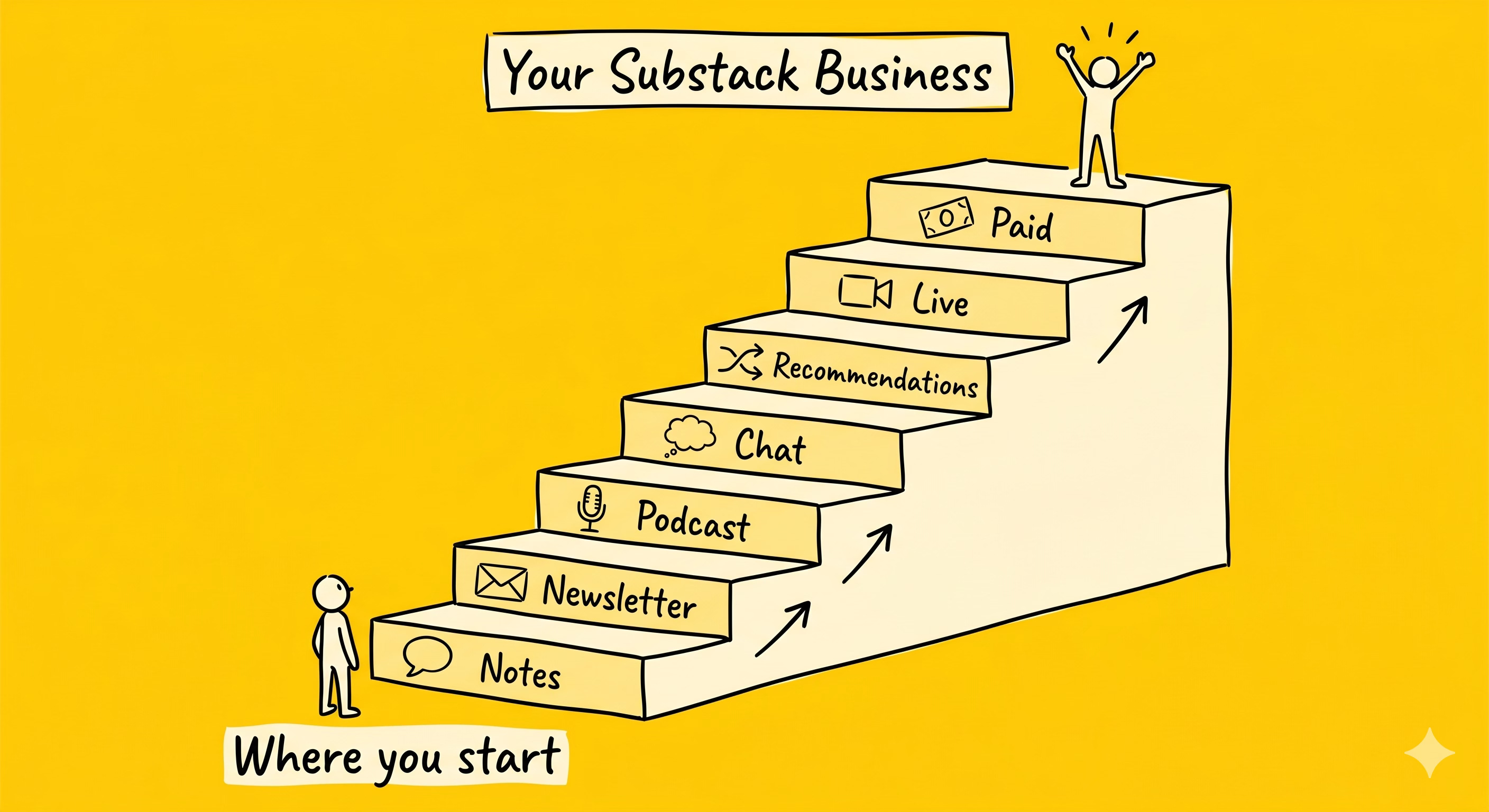
Seven steps. Seven features. Each one does a specific job in your business.
You do not need all seven running on day one. You need to understand which job each one does, and which one to activate next.
Let’s get into it.
THE MISTAKE THAT KEEPS BEGINNERS STUCK
I spent my first three months on Substack doing one thing.
Publishing newsletters. Waiting. Checking the subscriber count. Waiting.
Nothing moved.
Here is what I did not understand then: a newsletter alone is a product with no store, no window display, and no way for strangers to find it. You are writing into a room with the door shut.
Substack is not just an email tool. It has a discovery engine. A community layer. A monetisation infrastructure. A live broadcasting studio. A podcast platform. All of it is already built in, already free to use, and almost nobody is using all of it.
The solopreneurs who are growing fast are not better writers than you. They just have more of the machine switched on.
Here is how to switch it on, one step at a time.
STEP 1: SUBSTACK NOTES
Your discovery engine. Turn it on first.
Before anyone can trust you, they need to find you.
Notes is how strangers find you on Substack. It is the platform’s social feed. Short posts, public, shareable, algorithmically pushed to people who are not yet your subscribers. Your newsletter sits behind a subscription wall. Notes does not.
That asymmetry is everything.
One creator I follow closely was gaining 10 or more new subscribers every single day from Notes alone, 600 new subscribers in a few months, before running any kind of promotion. Recent data shows Notes driving over 90% of new subscriber growth for early-stage creators. The platform itself reported 32 million new subscribers in one quarter coming from within the Substack app, not from outside traffic.
That is the room you are missing by not posting Notes.
But here is the problem most people hit. They do not know what to write every day.
That is where the system matters more than the platform.
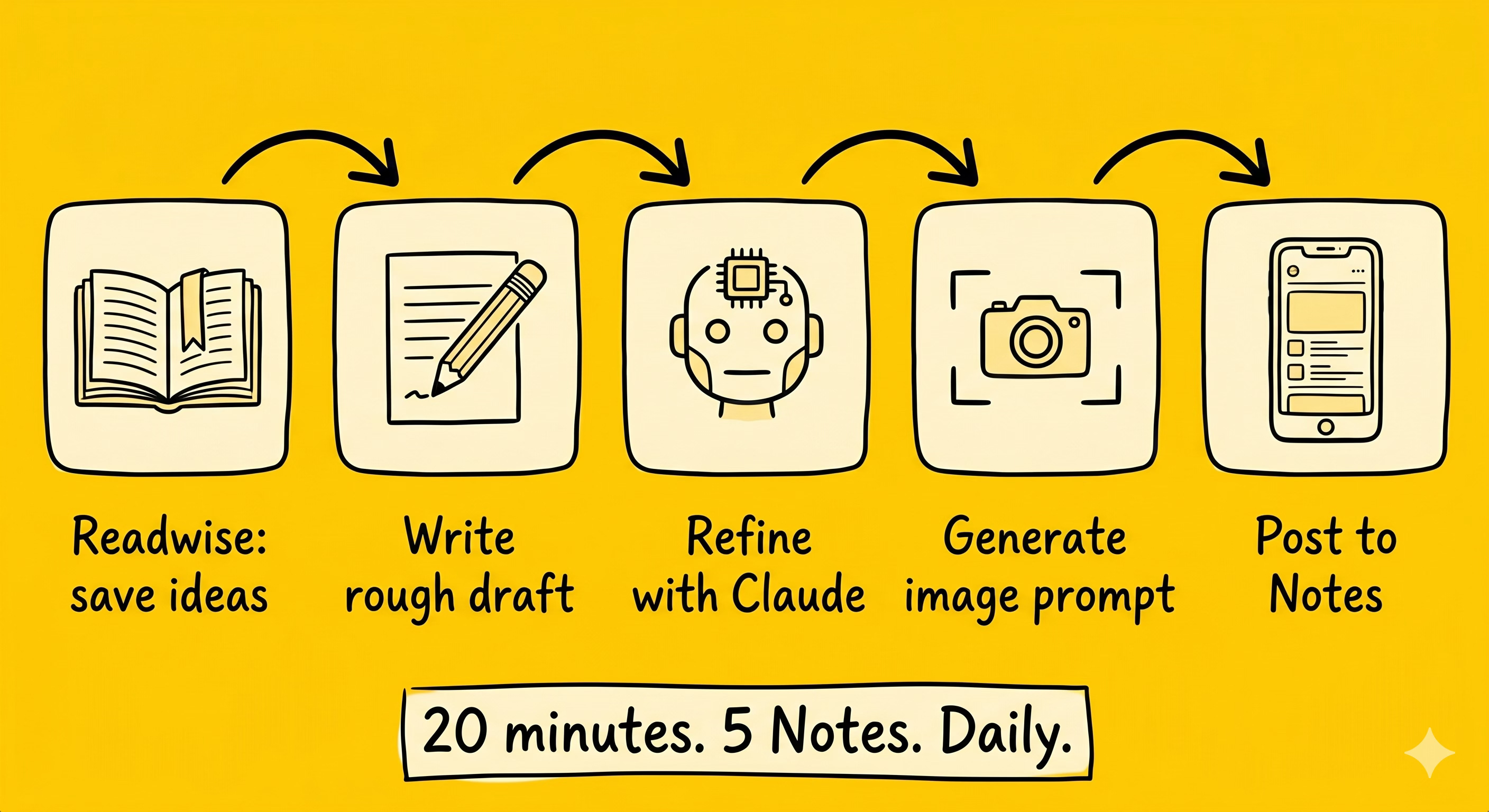
The workflow that makes five Notes a day feel easy
Step 1: Save to Readwise Reader.
Everything I read goes in. Articles. Book highlights. Newsletters. Ideas from a walk. When I sit down to write a Note, I am never starting from zero. I open my highlights and find an idea that already feels alive. The blank page problem, solved permanently.
Step 2: Write the rough draft.
One highlight. Three to five rough lines about what I actually think. Fast and messy. The goal is to capture the idea in my voice, not to polish it. The thinking is mine. The AI comes later.
Step 3: Refine with Claude.
I paste my rough lines into Claude with one instruction: sharpen the rhythm, keep my voice, remove anything robotic. Claude tightens without replacing. It is the editor, not the author. I run this inside Claude Cowork so the whole loop, draft to finished Note, stays in one place without breaking my focus.
Step 4: Write the image prompt with Claude.
Notes with images outperform Notes without. After writing the Note, I ask Claude to write a Gemini image prompt based on the theme. One line. Specific.
Step 5: Create the image in Gemini.
Thirty seconds. Done.
Five steps. Twenty minutes. Five Notes a day without burning out.
STEP 2: THE NEWSLETTER
Your trust engine. The thing you own.
Strangers found you through Notes. They clicked your profile. They subscribed.
Now your job changes completely.
You are no longer chasing attention. You are building trust. The newsletter is where that happens. It is the email relationship you own. Not Substack’s to take away. Yours.
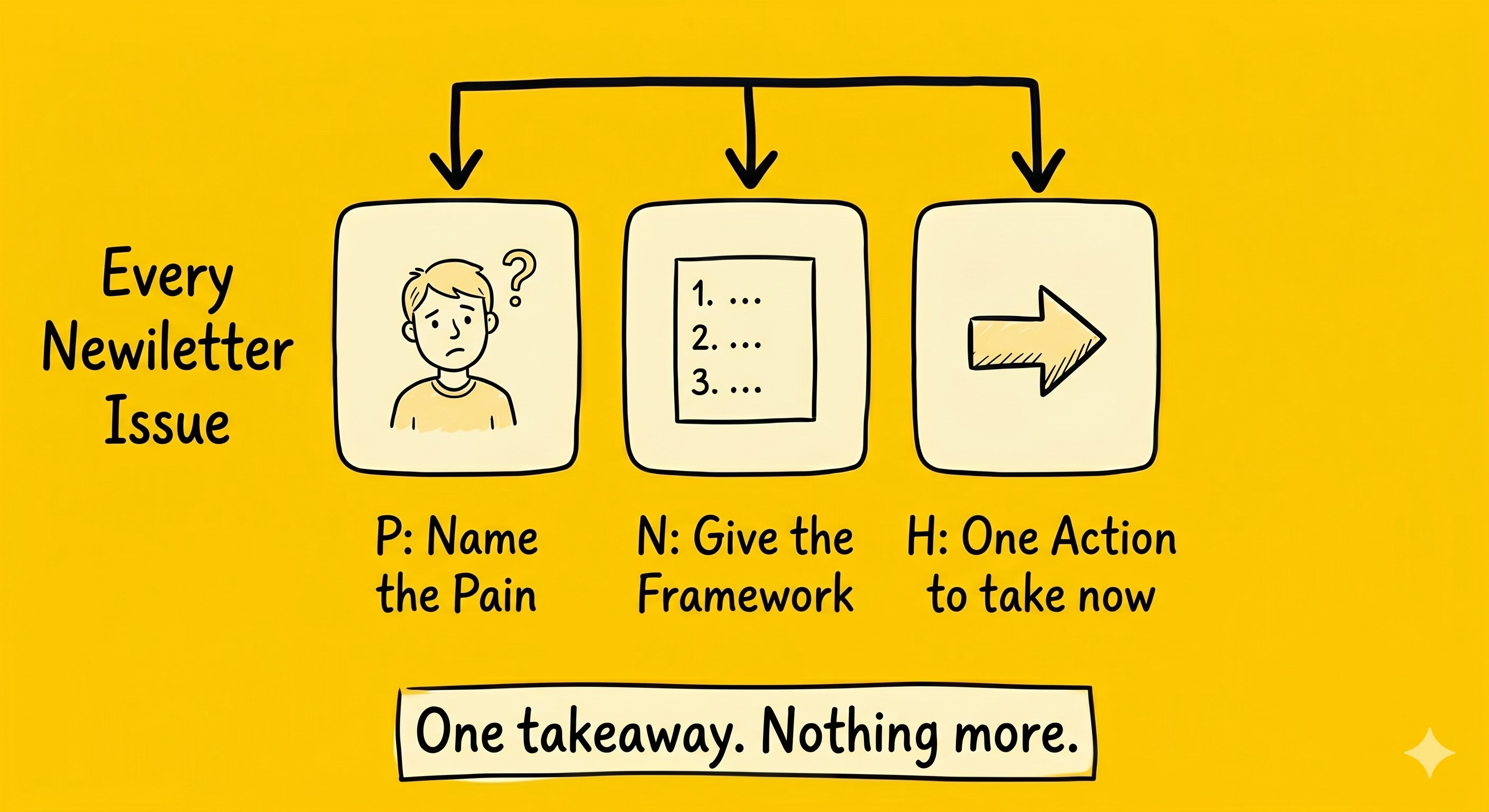
Every issue should do three things. Name the exact pain the reader is stuck on today. Walk them through a framework that solves it. End with one action they can take in the next ten minutes.
One clear takeaway per issue. Not five insights and a list of resources. One thing.
This discipline is what separates newsletters that feel professional from newsletters that feel like someone is just writing to fill space.
The test every issue should pass
After you finish writing, ask yourself one question. Could this have been written by anyone?
If yes, rewrite it. If it could only have come from your specific experience, your specific perspective, your specific story, it is ready to send.
Sahil Bloom built The Curiosity Chronicle to over 750,000 subscribers with no viral hacks. He writes about the same four themes every week. His readers always know what they are getting. That predictability is not boring. It is trust compounding.
You do not need 750,000 subscribers to apply this. You need 100 consistent readers who trust you completely. That is worth more than 10,000 passive followers who barely open your emails.
How Claude Cowork makes newsletter production sustainable
This is where the tool integration actually matters for consistency.
I use Claude Cowork as my production environment for each newsletter. My rough idea goes in, my Readwise highlights provide the supporting detail, and Claude helps me sharpen the structure without replacing the voice. The PUNCH framework, Pain, Unlock, Numbered steps, Callout, Handoff, keeps every issue tight and purposeful.
The key rule I follow: Claude refines. I write. The moment I let Claude generate the ideas, the newsletter stops sounding like me. And the moment it stops sounding like me, readers stop trusting it.
STEP 3: SUBSTACK PODCAST
Your intimacy engine. No studio needed.
Here is something I was slow to add but now consider irreplaceable.
A podcast does something a newsletter cannot.
When someone reads your newsletter, they are in their head with your words. When someone listens to your podcast, your voice is literally inside their ears for twenty or thirty minutes while they are driving, cooking, or at the gym.
That is intimacy at scale.
Substack has native podcast hosting built in. No extra subscription. No separate tool. Your audio episodes live right inside your publication. Substack automatically distributes your podcast to Apple Podcasts and Spotify through its RSS feed. You can also offer a private podcast feed exclusively to your paid subscribers, which we will cover in Step 7.
The format does not need to be complicated. You do not need a studio. A decent microphone and a clear idea are enough.
Here is the simplest format to start: pick one topic from your last newsletter. Record your expanded thoughts for 20 to 25 minutes. Publish it directly to Substack.
Your most engaged readers will become listeners. Your listeners will become your warmest, most loyal audience members. And Substack also has a built-in AI text-to-speech feature that can automatically narrate your written posts as audio if you are not ready to record your own voice yet.
That is a podcast with zero recording required.
What happens when your voice enters the room
Lenny Rachitsky built his paid subscriber base past 30,000 people. His podcast is the reason.
He does not do anything technically impressive. He shows up consistently. His listeners trust him because they have heard him think out loud for hundreds of hours.
You will not build that in a week. You will build it in a year if you start this week.
One short episode. Post it to Substack. See who listens.
STEP 4: SUBSTACK CHAT
Your community engine. The feature that retains subscribers.
Most creators think about growing their subscriber count. The creators who build real businesses think about retaining the subscribers they already have.
Substack Chat is how you keep people around.
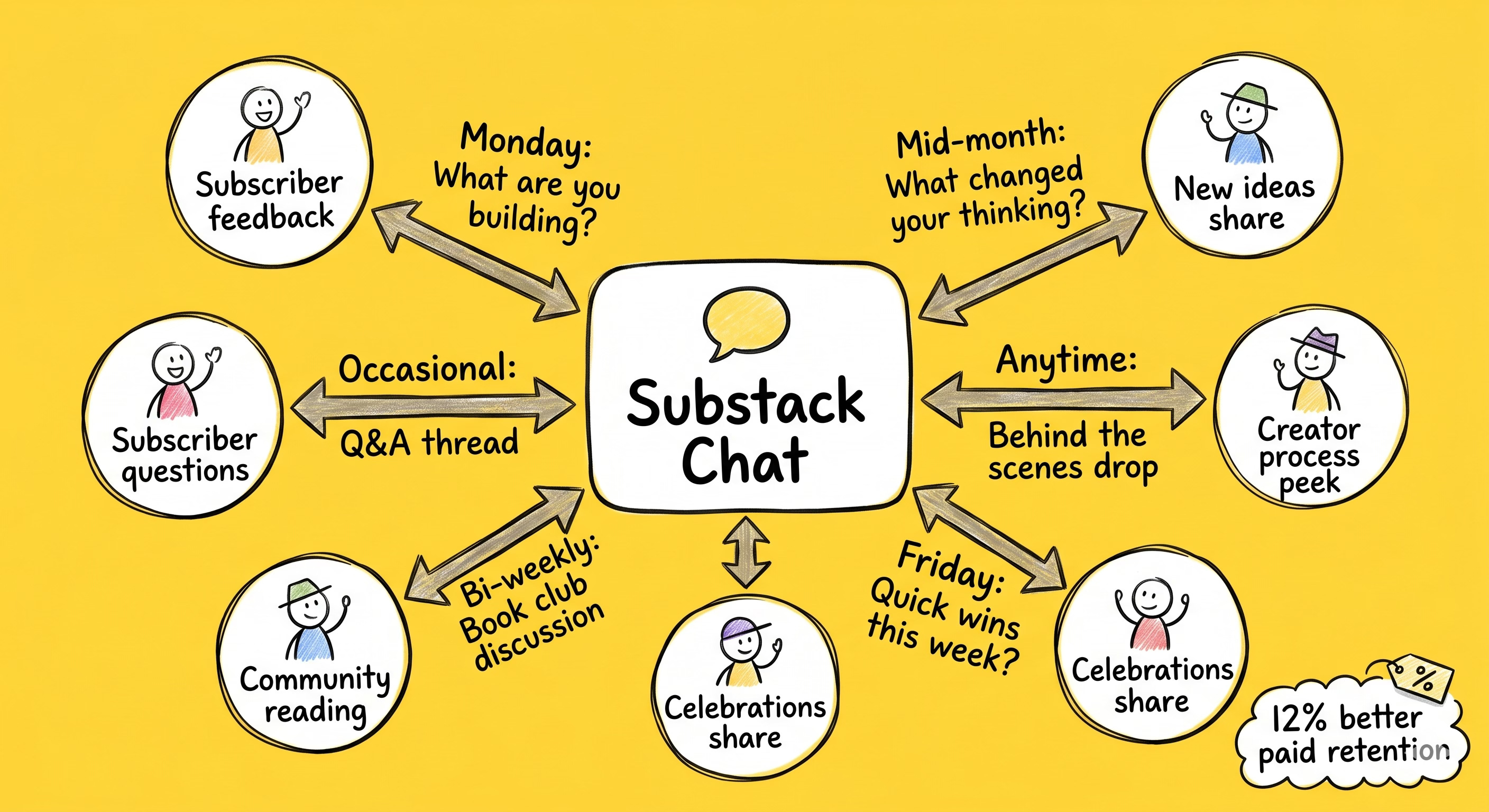
It is a real-time group conversation space, live inside your Substack. Think of it like a private Discord channel, but everyone who is in it already trusts you because they subscribed. Publications that use Chat consistently retain paid subscribers at a 12% higher rate than publications that do not. That is not a small number when you are thinking about recurring revenue.
How to use Chat without it taking over your life
The mistake creators make is treating Chat like a support queue. They feel like they have to respond to everything immediately. Exhausting.
The better approach: pick one or two recurring prompts and post them consistently.
“What are you working on this week?” Posted Monday. Drives momentum.
“Here is something I noticed that did not make it into the newsletter.” Posted whenever. Makes your engaged readers feel like insiders.
You are not hosting a chat. You are hosting a community with a shared problem. Make them feel like they belong to something.
STEP 5: RECOMMENDATIONS
Your growth engine. The most underused feature on the platform.
40% of all new Substack subscriptions come from inside the Substack network.
Read that again.
Not from Twitter. Not from SEO. Not from paid ads. From other Substack creators recommending each other.
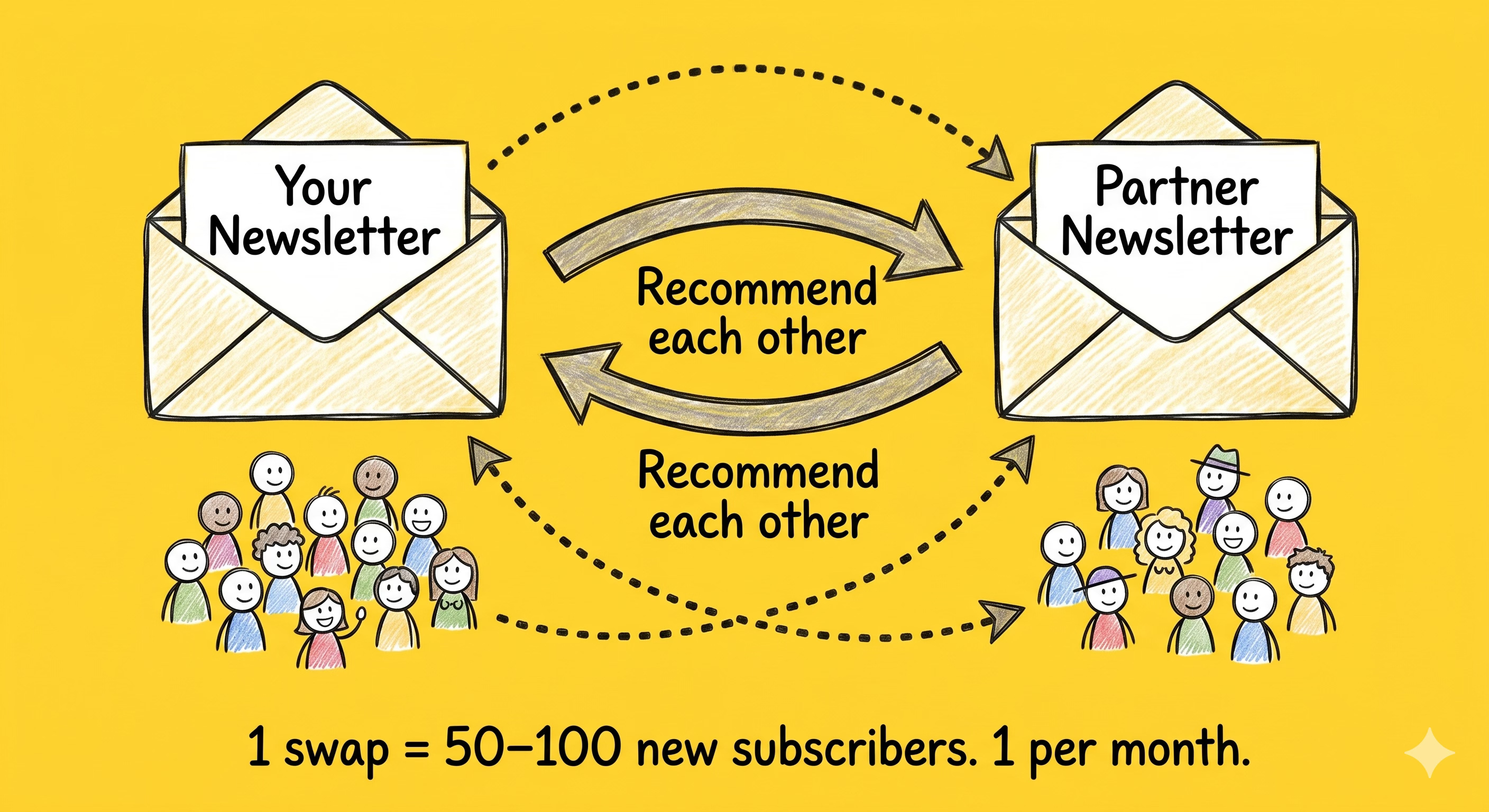
The Recommendations feature is Substack’s built-in cross-promotion engine. When you set up mutual recommendations with another creator, every new subscriber to their publication sees your name and a single-click button to follow you. And vice versa.
Individual recommendation swaps consistently generate 50 to 100 new subscribers per activation for creators in the 0 to 5,000 subscriber range. That is the highest-leverage free growth tool on the platform and most people have never turned it on.
How to find and approach the right recommendation partners
This is where most creators get it wrong. They approach the biggest newsletters in their niche and get ignored. Or they swap with anyone who asks and confuse their audience.
The right partner is a creator whose readers would genuinely benefit from your content, and yours from theirs. Same stage of growth. Different but adjacent topic.
If you write about solopreneurship, a good partner writes about productivity, or freelancing, or creator tools. Not another solopreneurship newsletter. Different topic, same reader profile.
Here is the approach I use. I find three or four Notes that performed well in my niche. I read which creators posted them. I subscribe. I engage genuinely for two or three weeks. Then I reach out with a simple, direct message: “Your audience and mine seem to have a lot of overlap. Would you be open to a recommendation swap?”
Most people say yes when you have already shown you are a real person with a real publication.
One swap a month adds up fast. Twelve swaps a year, even at the conservative end of 50 new subscribers each, is 600 organic subscribers you did not have to work hard for.
STEP 6: SUBSTACK LIVE
Your trust accelerator. One session = weeks of content.
Going live on Substack sends an email notification to your entire subscriber list.
No algorithm. No boosting. No paying for reach. Every subscriber gets notified the moment you go live.
That is a direct line to your whole audience, built into the platform for free.
Substack Live is the most underused growth tool most solopreneurs have access to right now. Here is why it works so well. Reading a newsletter builds familiarity. Listening to a podcast builds trust. But watching someone speak live, seeing them think in real time, ask questions back, and be genuinely present with their audience, that builds loyalty. A completely different emotional register.
What to actually do in a live session
You do not need slides. You do not need a big production. Here are three formats that work without any preparation:
Office Hours. Open a live session, tell your subscribers you are answering questions for 30 minutes, and just answer questions. This is the easiest live format to run and often the most valuable for your audience. The questions they ask live are also gold: they tell you exactly what your next three newsletters should be about.
Behind the scenes. Share what you are working on right now. An unfinished newsletter idea. A business decision you are wrestling with. A tool or workflow you just started testing. Vulnerability and specificity are what make live sessions worth showing up for.
Collab live. Invite another creator in your niche. You each bring your own audience. You both gain visibility. Substack has confirmed that collab live sessions with other creators are one of the strongest subscriber growth events on the platform.
One more thing: Substack automatically creates short clips from your live and shares them to your Notes feed. If you connect your YouTube account, your best clips get uploaded to YouTube Shorts automatically. One live session can become a week of content with no extra work.
STEP 7: PAID SUBSCRIPTIONS
Your income engine. This is where the business becomes real.
The first six steps do one thing above everything else.
They earn trust.
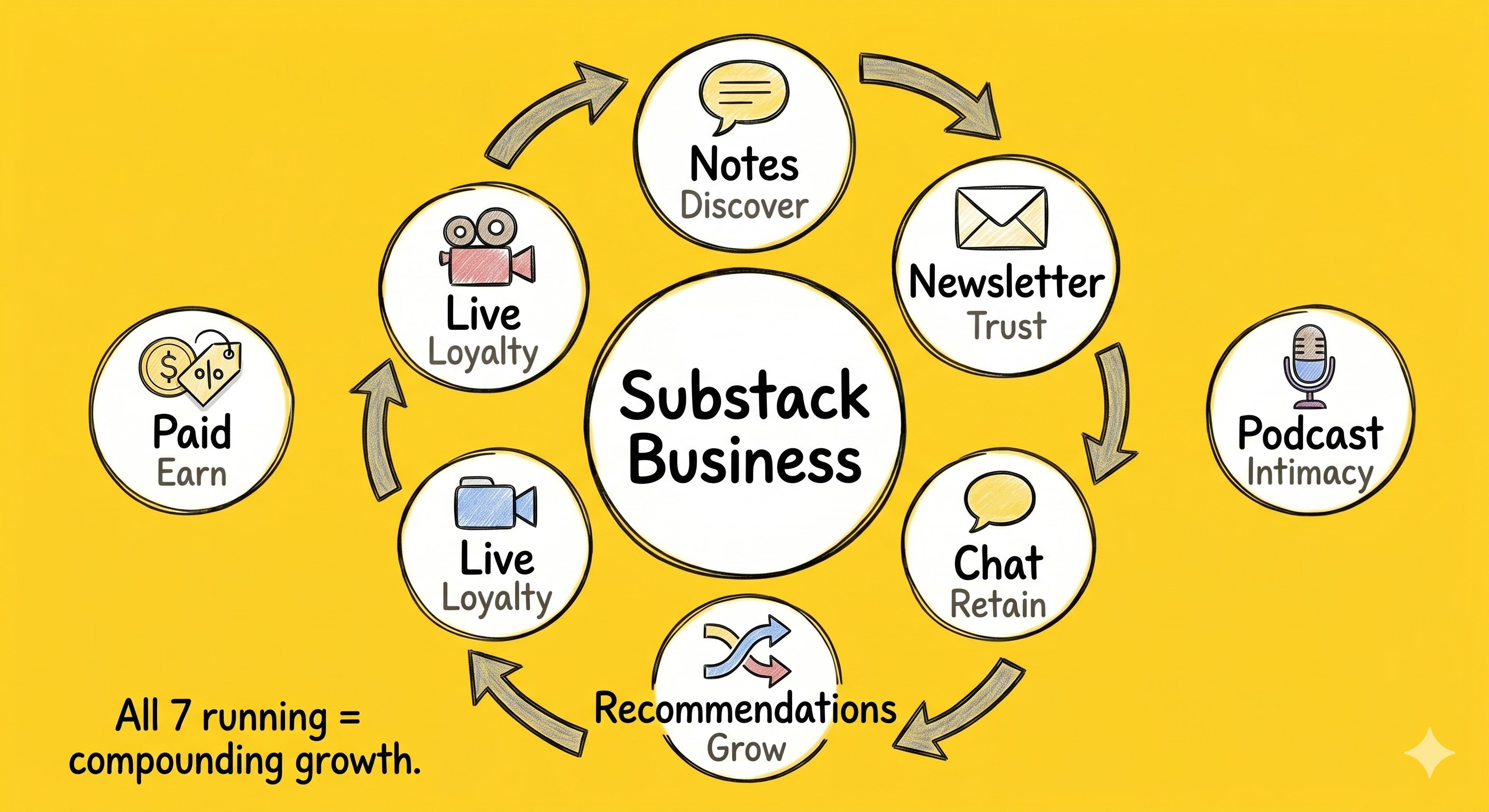
Notes finds you strangers. The newsletter builds familiarity. The podcast creates intimacy. Chat builds community. Recommendations compound your reach. Live creates loyalty. By the time someone has been in your orbit for four to six months across all of these, they do not feel like a subscriber.
They feel like a reader who knows you.
That is exactly who will pay for a paid subscription.
When to turn it on
Earlier than you think. The threshold most experienced creators use is around 300 to 500 free subscribers. You will not retire on the first month’s income. But you will know whether people value what you are building enough to pay for it. That signal is worth more than any subscriber count.
What paid subscribers actually get
The instinct is to put your best content behind the paywall. That is backwards.
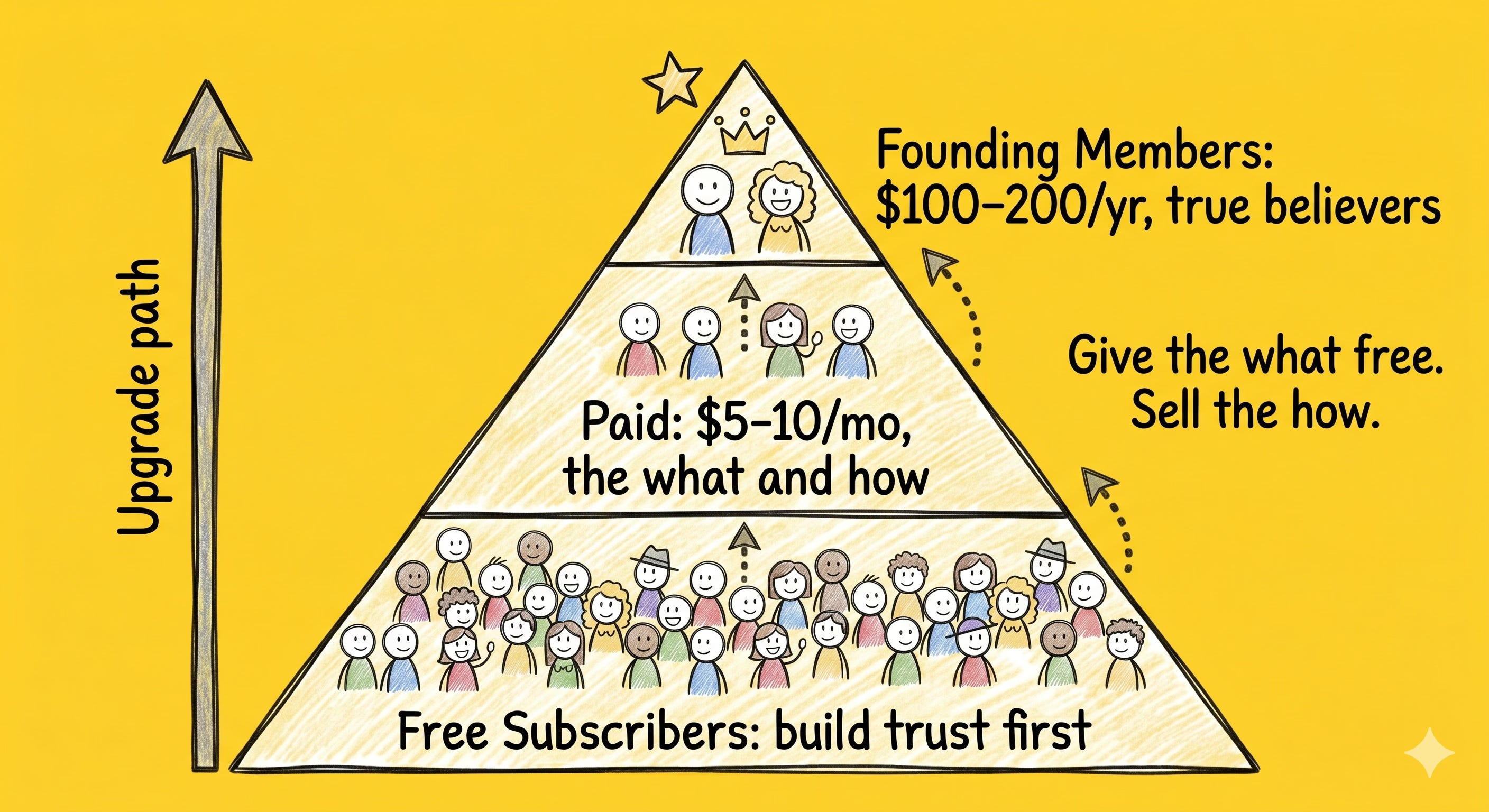
The model that works: give the what and the why for free. Put the how behind the paywall.
Your free newsletter teaches a strategy. Paid subscribers get the template, the exact prompts, the step-by-step guide. Free proves you are worth listening to. Paid lets committed readers go deeper with you.
Founding Members: the feature most beginners overlook
Substack gives you a Founding Member tier when you turn on paid. It is an optional higher-priced plan for your most loyal supporters.
Standard paid is typically five to ten dollars a month. A Founding Member price might be one hundred to two hundred dollars a year.
These people are not paying for more content. They are paying because they believe in what you are building.
Give them something personal: early access, a monthly voice note, a direct reply thread. The specific perk matters less than the signal. You see them. They matter to you.
Founding Members create the financial floor that makes long-term consistency possible. When the basics are covered, you stop creating from fear and start creating from clarity.
THE COMPLETE PICTURE: How All 7 Steps Work Together
Every day, Notes bring in new strangers through Readwise, Claude, and Gemini. Twenty minutes. Done.
Every week, two newsletters build trust. One podcast episode creates intimacy. One Chat prompt keeps your community alive.
Every month, one recommendation swap adds 50 to 100 subscribers without a single ad. One live session reaches your whole list directly, and Substack clips the best moments into Notes automatically.
Always running: paid subscriptions, open to anyone who is ready to go deeper.
Every part feeds the next. Notes fills the top. Newsletter and podcast build the middle. Chat and Recommendations compound retention. Live locks in loyalty. Paid turns all of it into income.
THE REAL REASON MOST PEOPLE NEVER BUILD THE BUSINESS
It is not strategy.
They just do not feel ready yet.
“I will turn on paid when I have more subscribers.” “I will start the podcast when I have better equipment.” “I will go live when I know what to say.”
Every one of those sentences is the same belief: that the business starts after the preparation is done.
It does not.
The preparation IS the business. The figuring-it-out is the content.
Justin Welsh built a one-person business worth over five million dollars. He did not wait until he had it figured out. He built in public. The documentation of the journey was the product.
Your readers do not need you to have it together. They need you to be honest about figuring it out.
Show up with what you have. Add one step at a time.
THE TAKEAWAY
Substack is not a newsletter tool.
It is the most complete one-person business infrastructure available to independent creators right now. Notes is your discovery. The newsletter is your trust. The podcast is your intimacy. Chat is your community. Recommendations are your growth engine. Live is your loyalty accelerator. Paid subscriptions are your income.
Seven features. One business.
Most creators are using one or two. The ones using all seven are building something that compounds every week without burning out.
That is the real secret. Not a growth hack. A system.
Reply and tell me which step you are on right now. I will write the next deep dive based on the most common answer.
Mike, probably one of the best pieces I've read on building in this platform. Thank you for this! I had a podcast about 2 years ago. Because of this article I'm going to jump back into it .
Awesome blueprint Mike! Thanks for sharing this. Have you thought about doing the Live first, turning that into the podcast and then using that for the newsletter content? I find I can talk into the camera about a topic better and then refine it into the newsletter content or into multiple notes later.