

I Wasted 3 Years Finding the Right Niche as Newsletter Writer
For me, the MISSION Approach transformed my life.

Every newsletter guru says the same thing.
“Pick a niche. Narrow it down. Focus on one thing.”
I tried it. Picked productivity for freelancers. Wrote six issues. Then hit a wall.Not because I ran out of ideas. Because I ran out of care.
The niche was technically sound. But it wasn’t mine. I built it because it seemed viable, not because it lit something up inside me.
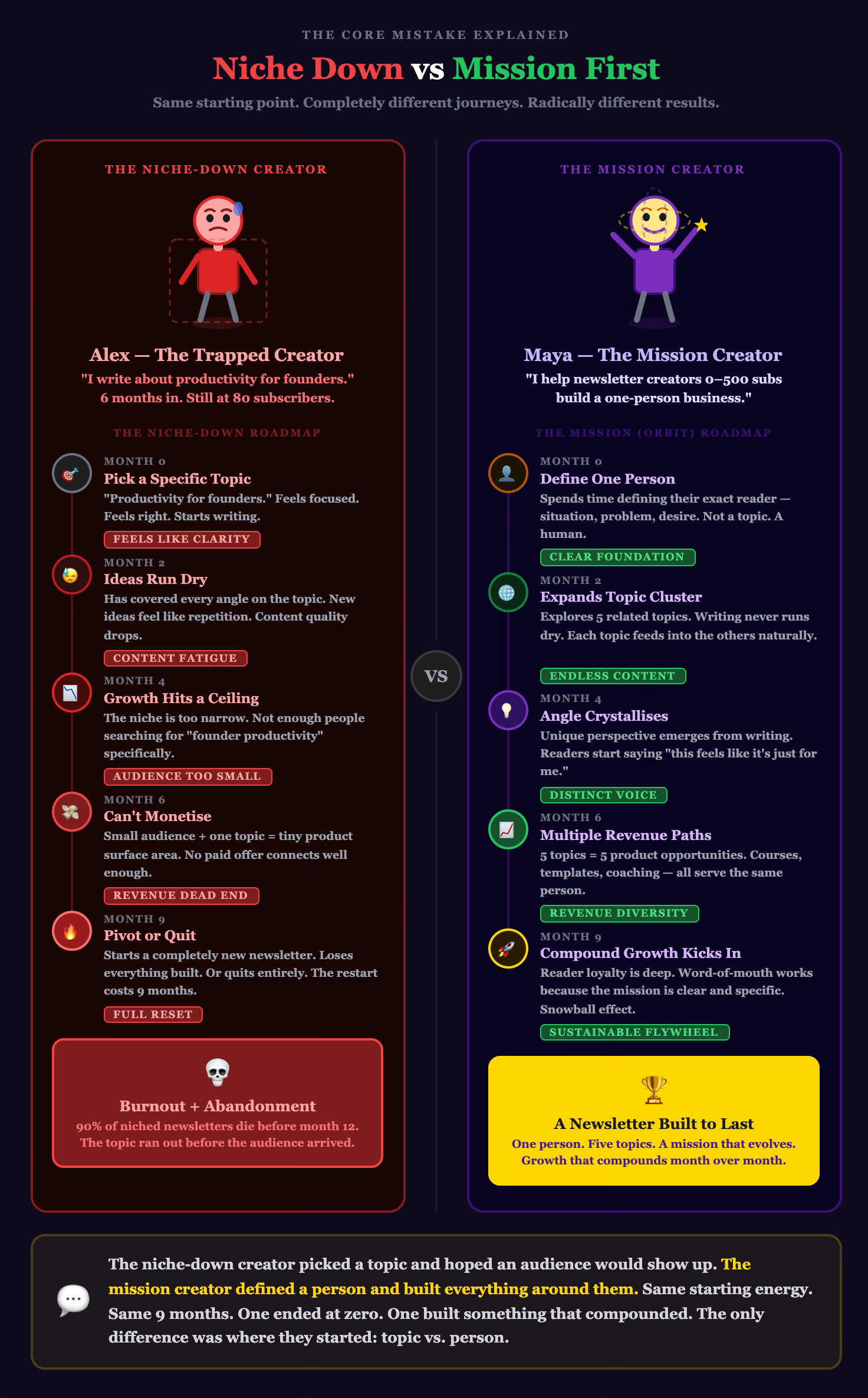
Here’s what nobody tells you about niching down. The moment your curiosity dies, your newsletter dies with it. And curiosity cannot live in a box.
The advice to pick one narrow topic sounds logical. It just doesn’t reflect how humans actually work.
We are built to explore, experiment, connect ideas, and build perspective across a range of things. That is not a flaw. That is your biggest creative advantage.
But there is a catch. You cannot just write about everything. Random is not a strategy.
What you need is a framework that widens your scope without losing focus. One that lets you explore multiple interests, builds a genuine perspective, and ties everything back to one kind of person you are here to help.
I call it the ORBIT Framework. And today, I’m walking you through it.
Here’s what we’re covering today:
🎯 1. Why “Niche Down” is a Trap — and what it costs you long-term
🌍 2. The ORBIT Framework — five steps that keep you focused without boxing you in
🔍 3. Real creators who prove it works — Sahil Bloom, Dan Koe, James Clear
🧩 4. How to find your topic cluster — the related interests that connect naturally
🔬 5. The 3-Phase Experiment Method — how to test without quitting
⚡ 6. Your one action this week — start here if nothing else
Why “Niche Down” is a Trap
The Problem With Picking One Topic
Here is what happens when you niche down too early.
You pick a topic before you know yourself. You write about it because it looks successful for someone else. For a few months, it feels exciting.
Then it gets boring.
Not boring to read. Boring to write.
When it gets boring to write, the quality drops. The consistency drops. Then you stop showing up entirely.
The problem is not your discipline. It is that you committed to an idea before you actually loved it.
The ORBIT Framework:
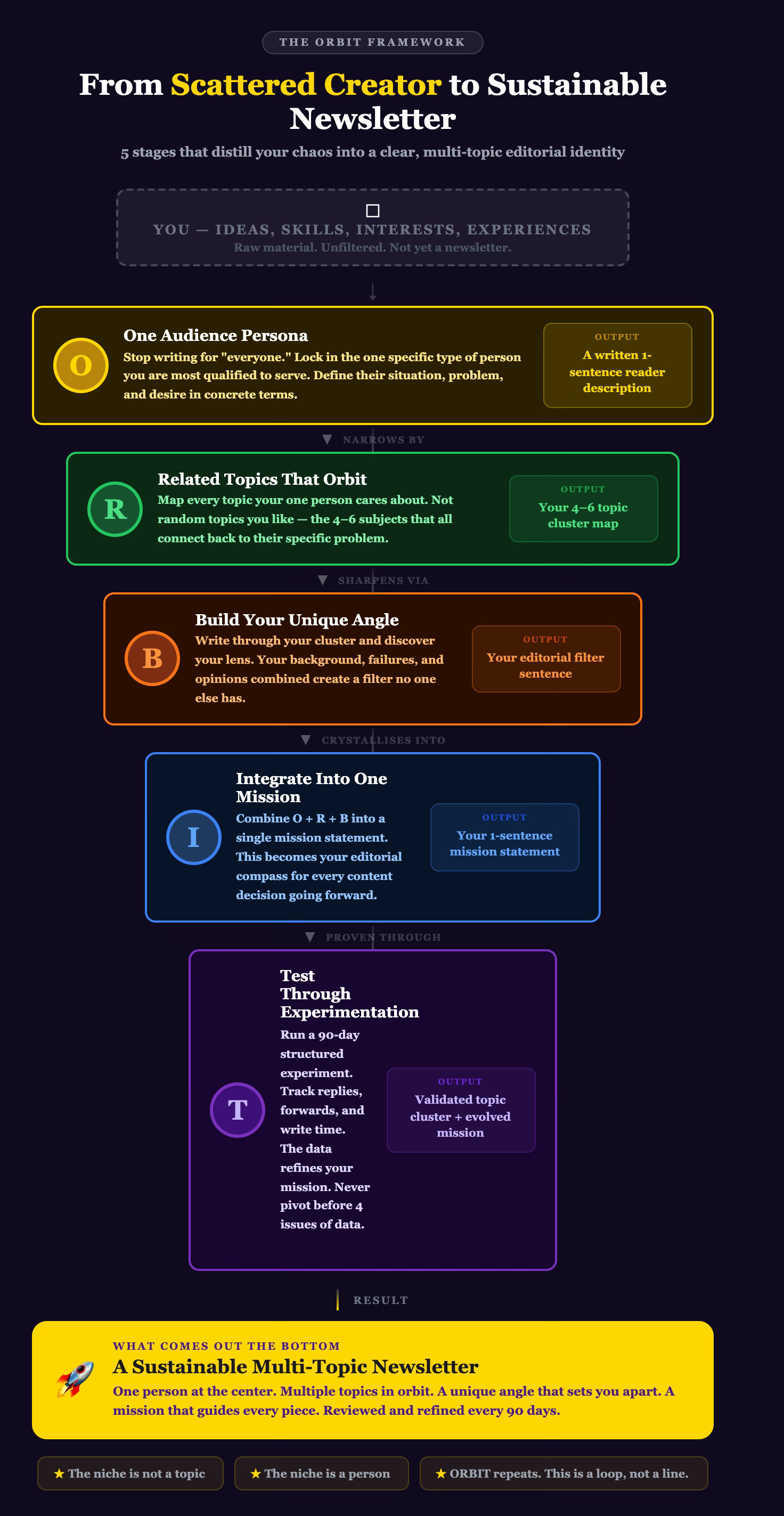
The ORBIT Framework has five parts. Each one builds on the last.
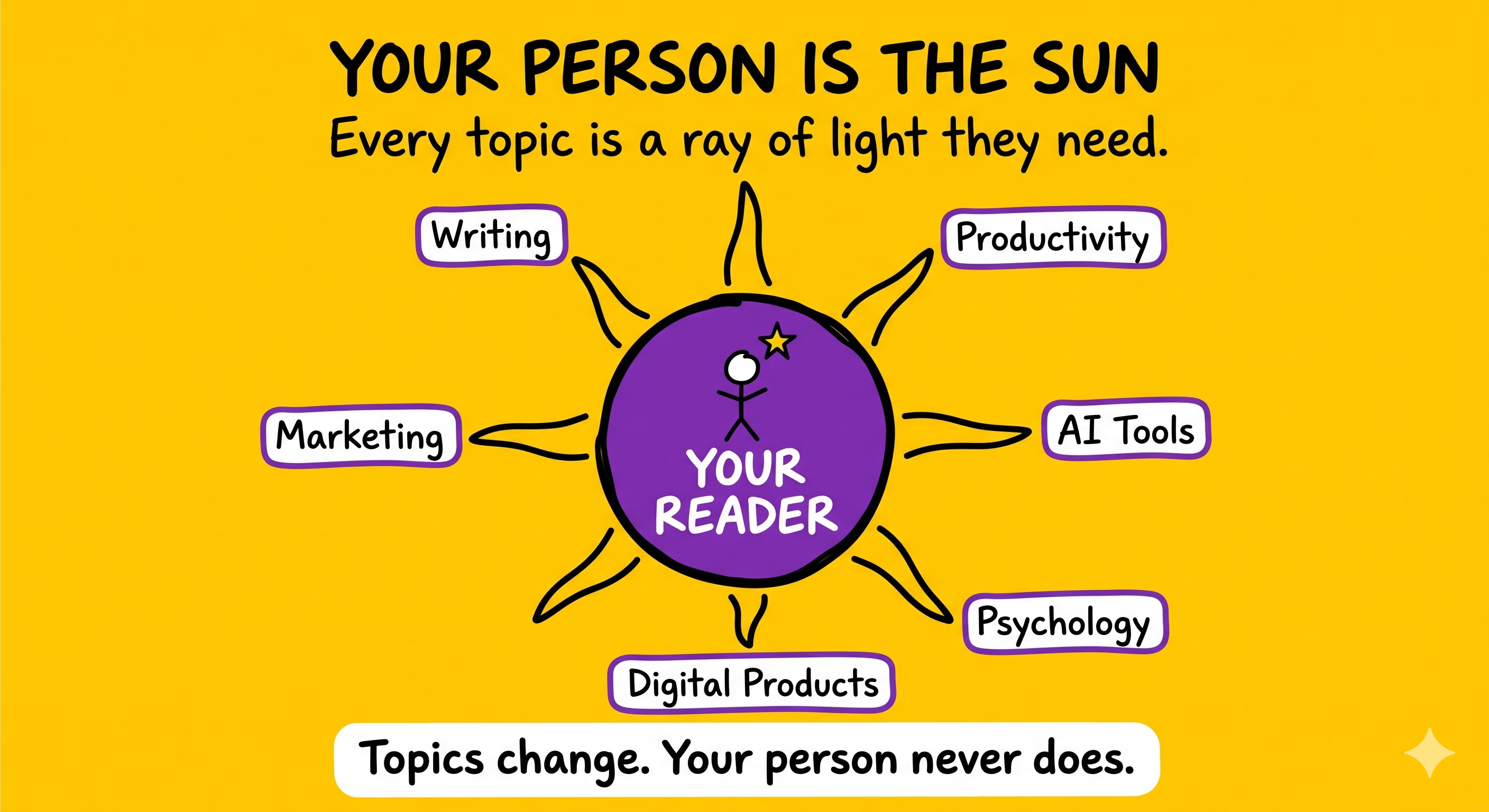
O — One Audience Persona (your sun)
R — Related Topics that orbit around them
B — Build your unique angle through all of them
I — Integrate into one clear mission
T — Test through structured experimentation
Let me break each one down.
2.1 O — One Audience Persona
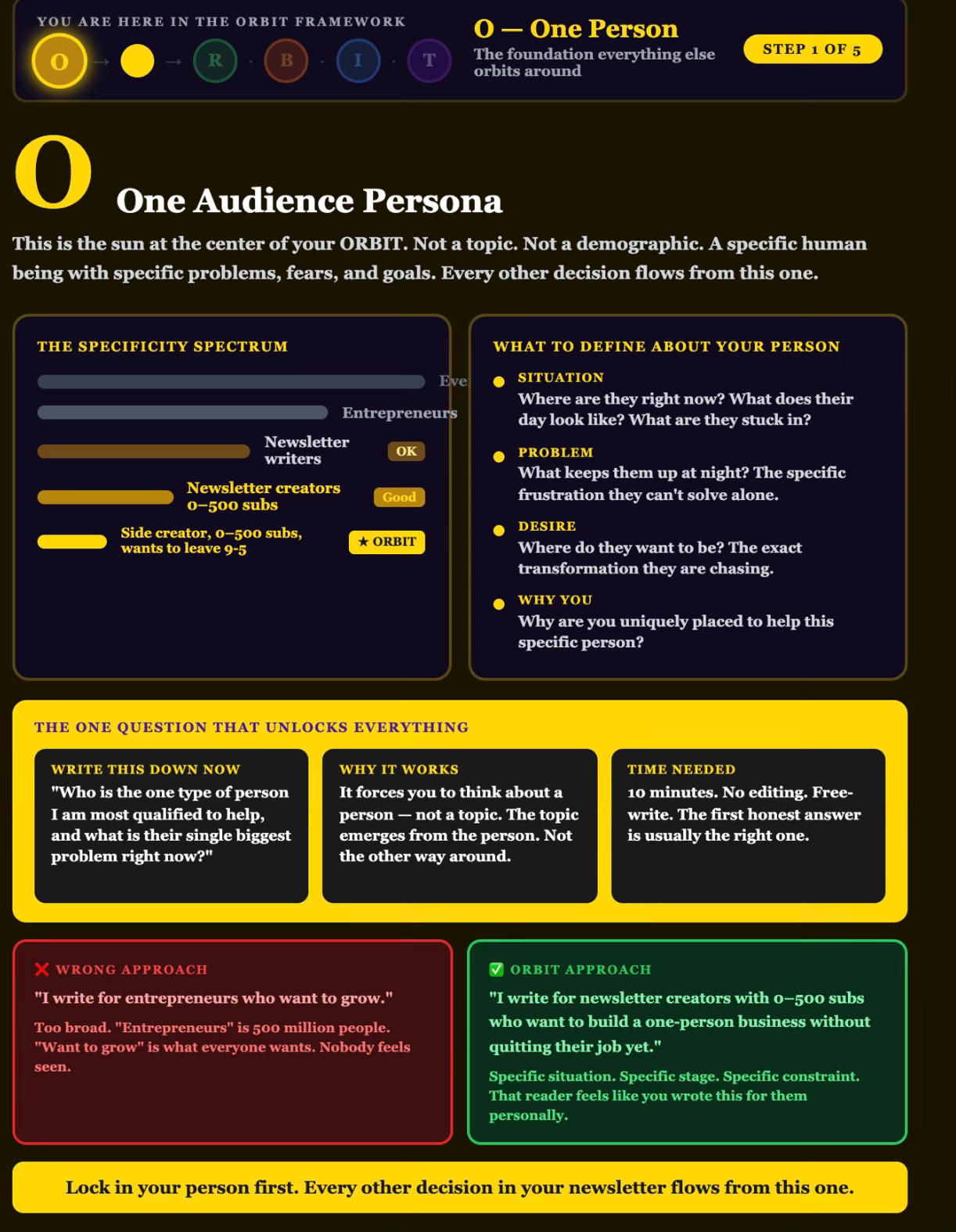
Everything starts here.
Not “what do I write about?” but “who am I writing for?”Get specific. Not “entrepreneurs.” Not “people who want to grow.”
Try this instead: “I write for newsletter creators with 0-500 subscribers who want to build a business without leaving their 9-5 yet.”
That is a person. With a specific situation. With specific fears and goals.
When you have that person locked in, every topic becomes a tool. AI tools, productivity systems, mindset, digital products, pricing strategy. All of it becomes content if it solves a problem for that one person.
The person is your sun. Everything else orbits around them.
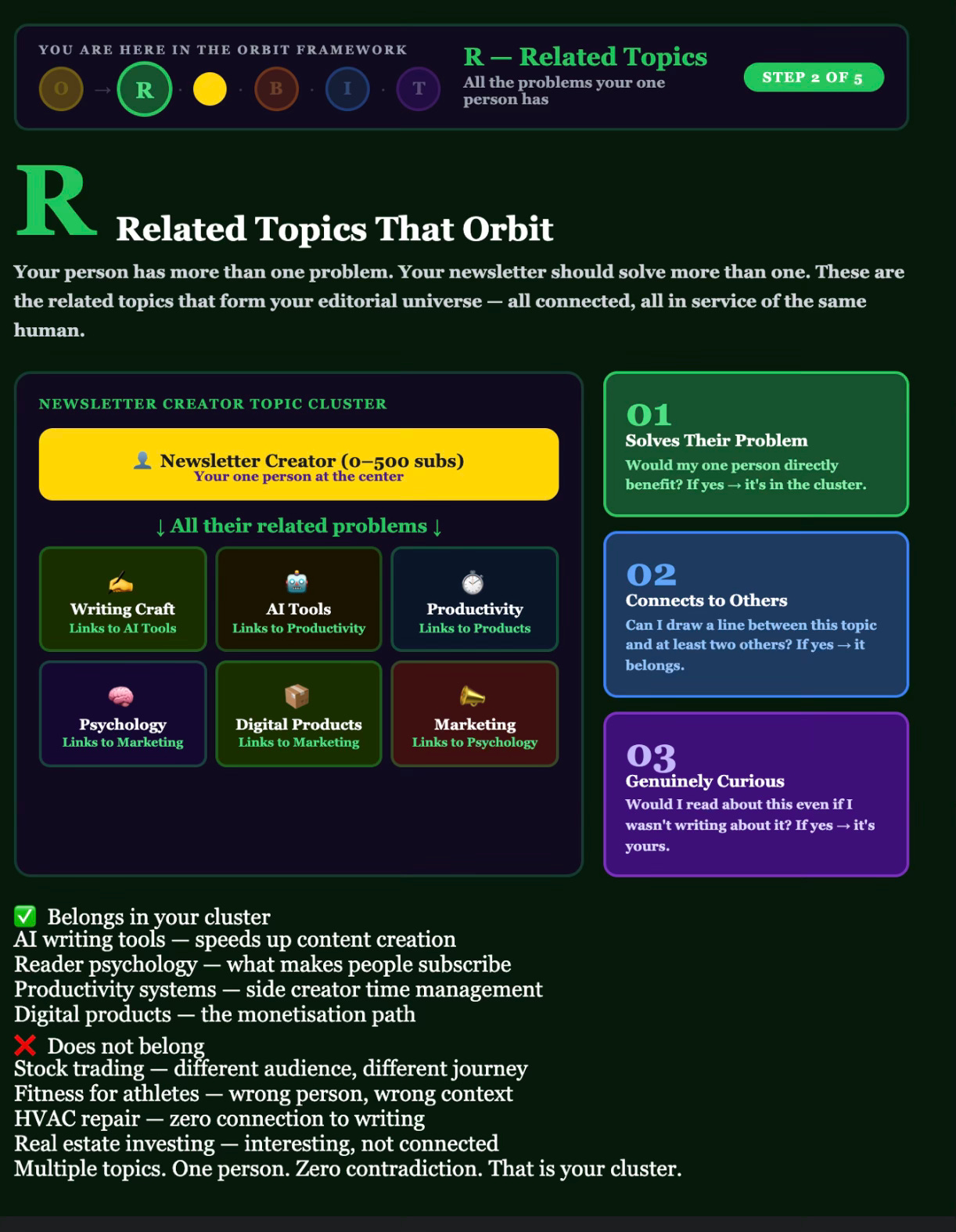
2.2 R — Related Topics That Orbit
Here is where most creators get it wrong.
They think multiple topics means random topics.
It does not.
The topics have to be related. Not in the sense that they live in the same Wikipedia category. Related in the sense that they all serve the same person’s journey.
Take newsletter creators as an example. To build a successful newsletter business, they need:
Writing skillsqaq1. Content strategy. Productivity systems. AI tools. Basic psychology. Digital product creation. Simple marketing.
Seven different topics. One complete picture of what a newsletter creator needs to succeed.
That is a topic cluster. Every piece you write lives inside it. Nothing feels random because every piece serves the same person’s growth.
The key rule: each topic should be related to at least one other topic in your cluster. They do not all need to connect to each other directly. They just need to connect through the person you serve.
2.3 B — Build Your Unique Angle
Here is something nobody talks about.
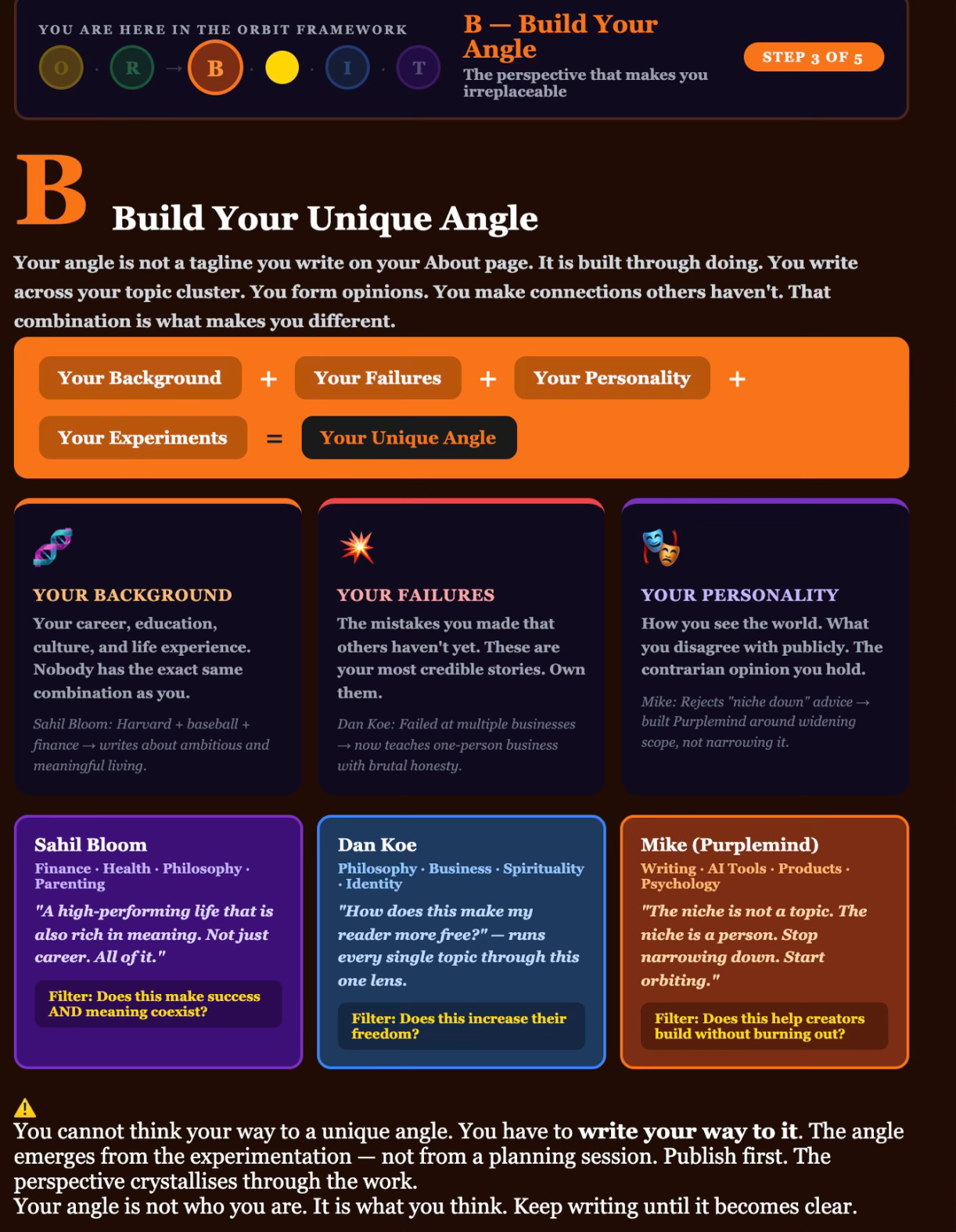
Your unique perspective is not a tagline you write on your About page. It is built through experimentation.You explore a topic. You form opinions. You make connections others have not made. You bring your background, your failures, your personality into it.
That combination is what makes you different.
Sahil Bloom writes about business, investing, parenting, health, and philosophy. But his angle is always: “How do you build a high-performing life that is also rich in meaning?” That angle is distinctly his. Nobody else has his Harvard background plus his career pivot plus his personal voice.
Dan Koe writes about productivity, psychology, spirituality, and business. His angle: “How do you design a life that makes you free?” Every topic runs through that one filter.
Your angle emerges when you commit to the experimentation. You cannot think your way to it. You have to write your way to it.
2.4 I — Integrate into One Mission
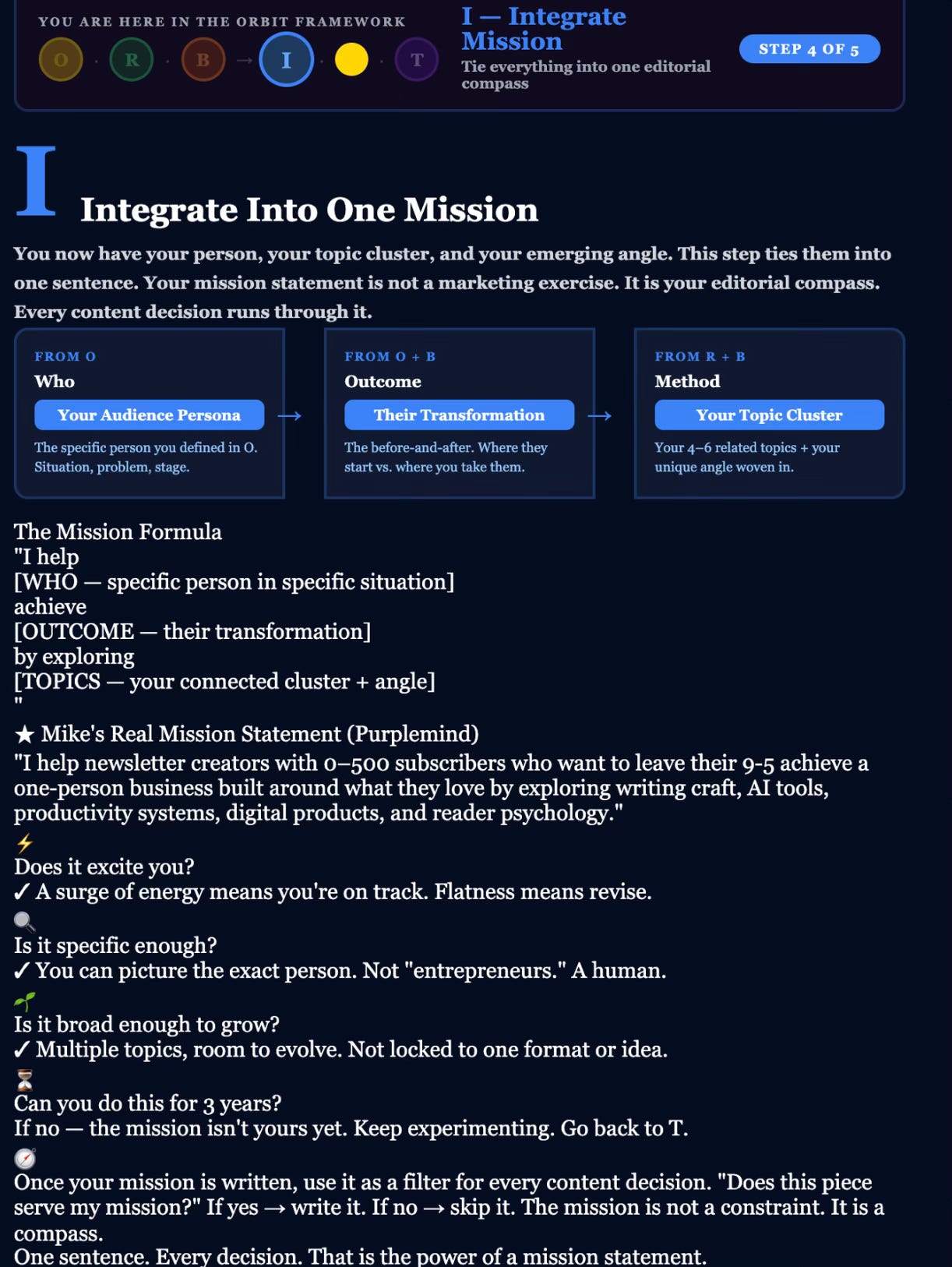
This is your North Star.After you know your person, your topic cluster, and your angle, you write one sentence that ties them together.
Use this format: “I help [specific person] achieve [specific outcome] by exploring [your topic cluster].”
Example: “I help newsletter creators build a one-person business by covering writing, AI tools, productivity, and digital product strategy.”
That sentence is your editorial compass. Every issue you write either fits that sentence or it does not.
When you are unsure whether to write about something, run it through your mission. Does it help your person? Does it fit your cluster? If yes, write it. If no, skip it.
Simple. Clear. Decisive.
2.5 T — Test Through Experimentation
Your mission is not fixed. It is living.
You will iterate. Your audience will teach you things. Topics you thought would flop will take off. Topics you loved will get zero response.
That is not failure. That is the system working.
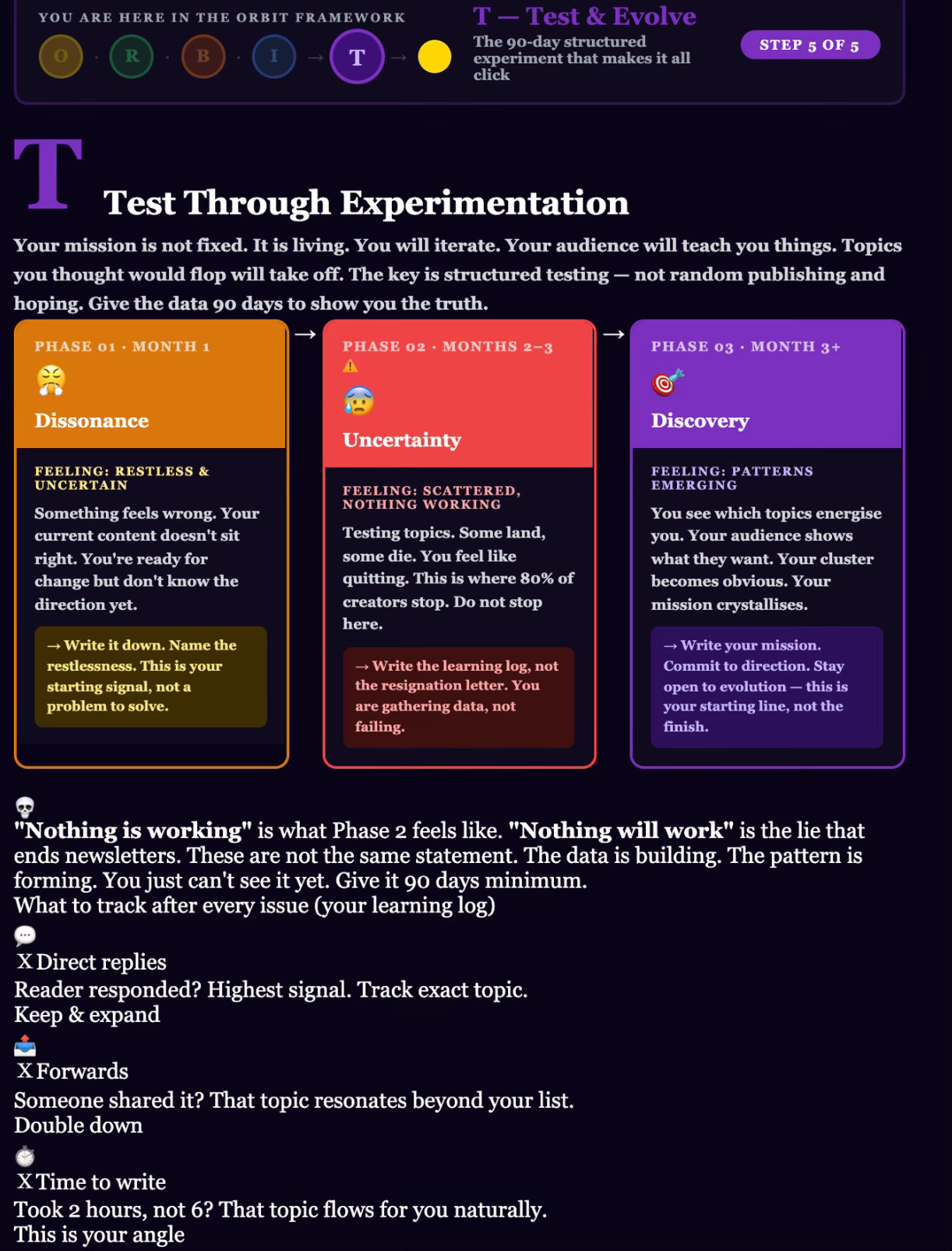
The key is structured testing. Give each topic or format at least 4 issues before you judge it. Track what gets replies. Note what people forward. Pay attention to which issues you wrote in two hours versus which ones took two days.
That data tells you where to go next.
4. How to Find Your Topic Cluster
Finding your cluster is not complicated. But it takes honesty.
Start with your audience persona. Write down every problem they have. Not just the obvious ones. Go two layers deeper.
A newsletter creator’s obvious problem is “I don’t have enough subscribers.” Dig further. They also struggle with:
Not knowing what to write about. Impostor syndrome. Time management as a side creator. Basic marketing. Building their first digital product. Using AI without sounding robotic.
That is six topics. All connected. All for the same person.
Three rules for a healthy topic cluster:
Rule 1: Every topic must solve a real problem your person actually has.
Rule 2: The topics must naturally connect to each other. Psychology and productivity connect. Psychology and HVAC repair do not.
Rule 3: You must be genuinely curious about at least three of the topics in your cluster. Not all of them. Just most of them.
If your cluster passes these three tests, you have your editorial universe.
5. The 3-Phase Experiment Method
Most creators quit during the experimentation phase because they mistake confusion for failure.
Here is the truth: confusion is not failure. It is the process.
There are three phases you will move through. Sometimes in order. Sometimes all at once for different topics.
Phase 1 — Dissonance. You know something needs to change. Your current content does not feel right. You are restless but unsure why. This is your signal to experiment, not quit.
Phase 2 — Uncertainty. You are testing topics. Some land, some don’t. You feel scattered. This is completely normal. You are not lost. You are gathering data. Write the learning log, not the resignation letter.
Phase 3 — Discovery. Patterns emerge. You see which topics light you up and which ones your audience responds to. Your cluster becomes clear. Your angle solidifies.
The mistake most creators make is quitting in Phase 2 because it feels like nothing is working.
Nothing is working yet. That is different from nothing will work.
Give yourself 90 days. Three months. Write consistently. Track what gets responses. Stay inside your topic cluster. Your mission will find you.
One last thing.
The creators who last are not the ones who found the perfect niche on day one.
They are the ones who committed to a person, stayed curious about that person’s world, and kept showing up long enough for their unique angle to emerge.
You are not scattered. You are building.
Keep going.
Mike
Very thorough and interesting. I appreciated your emphasis on what lights us up as writers and boosts our own curiosity and enjoyment to write. That turned out to be key for me!