

Same Knowledge: Different Tier- One Made $0 One Made $2,000 in 20 Minutes
Why where you place your offer matters more than what's inside it

Everyone told me to build a course. I had 200 subscribers and zero proof I could teach anyone anything.
I built it anyway. Launched it. Heard nothing.
Two weeks later I emailed one person, offered to do the same work myself, charged $2,000. They paid in 20 minutes. Same knowledge. Different tier. Completely different result.
WHAT YOU’LL GET FROM THIS
A 3-tier framework for placing digital products. Two axes that decide everything. One honest question you have to answer before you build anything.
By the end, you’ll know exactly which tier fits your current stage and when to climb.
THE REAL PROBLEM
Most people pick the wrong tier first.
They see someone selling a $997 course and assume that’s the play. Four months of modules later, they launch. Silence. No sales. They blame the product, the audience, the algorithm.
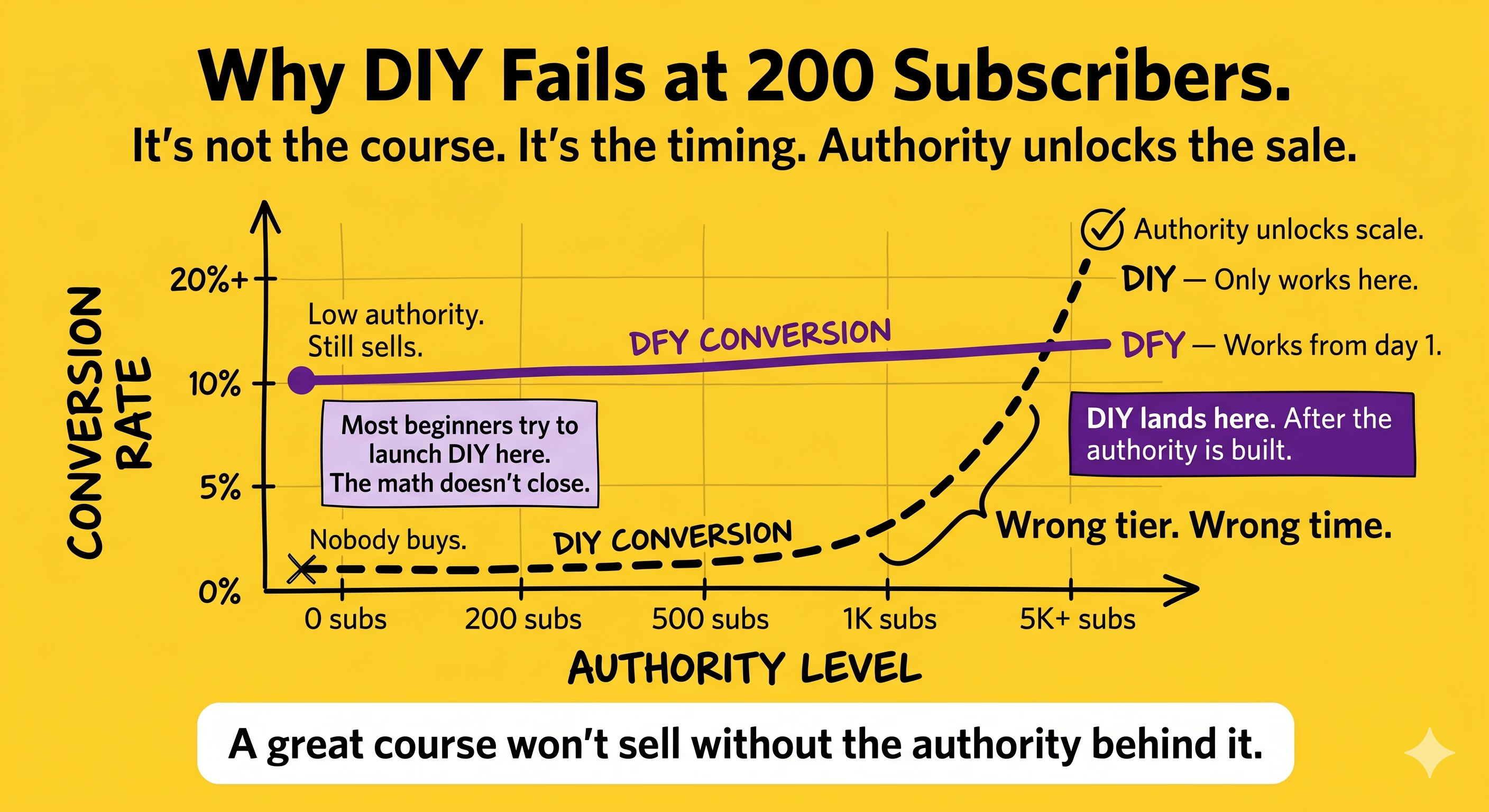
That’s not what happened. What happened is they asked people to trust an unproven method with their own time and money. That’s a hard sell at 200 subscribers.
Digital products don’t fail because the content is bad. They fail because the seller is on the wrong tier for their current stage.
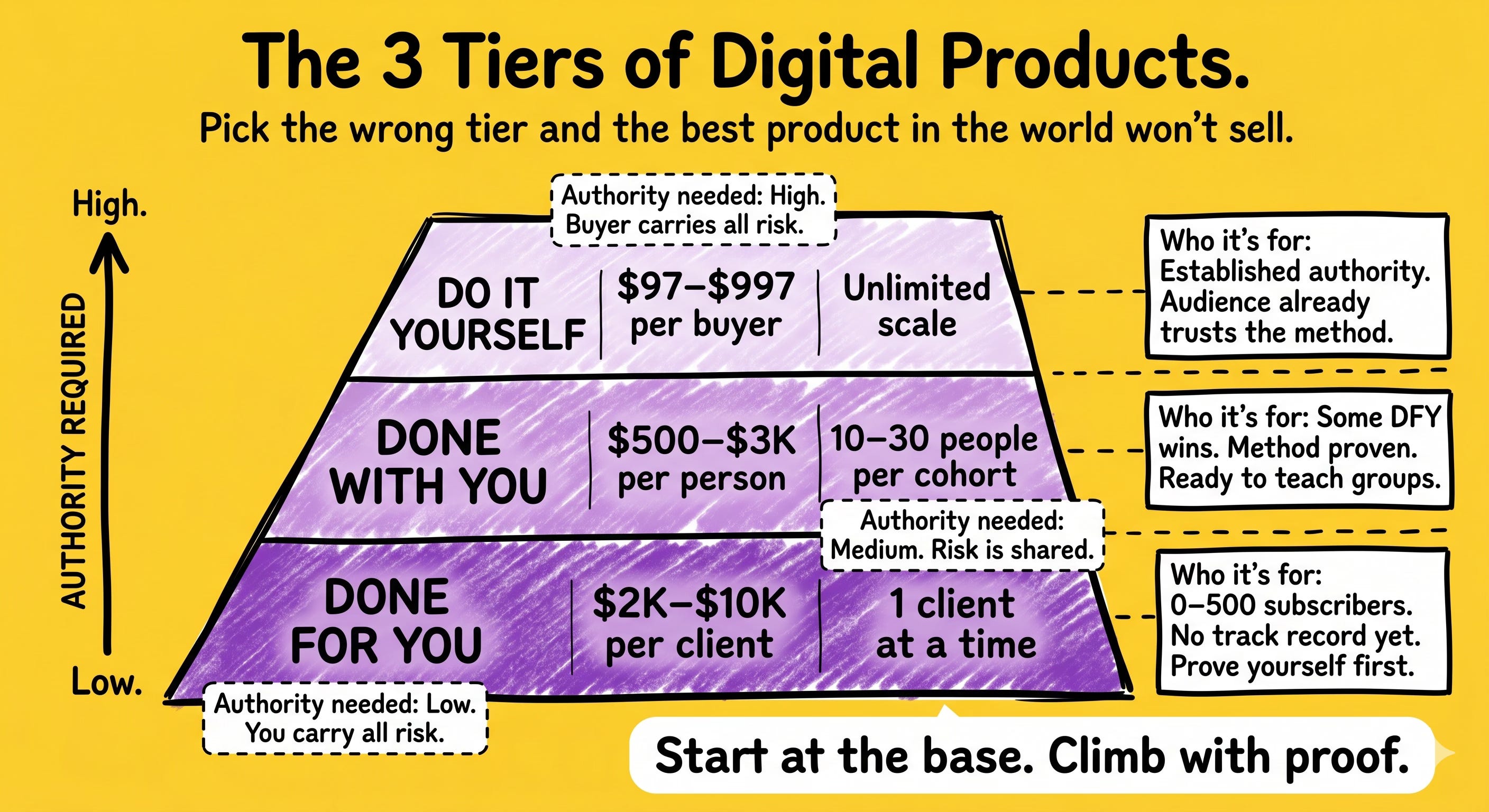
Here’s what nobody says out loud. Every digital product sits on one of three tiers. Which tier you belong on right now depends on two things: how much authority you’ve built, and how scalable you need your income to be.
Get that match right and the product sells. Get it wrong and even a brilliant course goes nowhere.
THE TIERS FRAMEWORK
Five letters. Three tiers. Two axes.
T for Trust threshold you currently have.
I for Intensity of effort per client you can commit.
E for Earning model and price ceiling you’re aiming for.
R for Risk responsibility. Who carries the outcome.
S for Scalability ceiling you want to hit.
Every digital product decision lives inside those five factors.
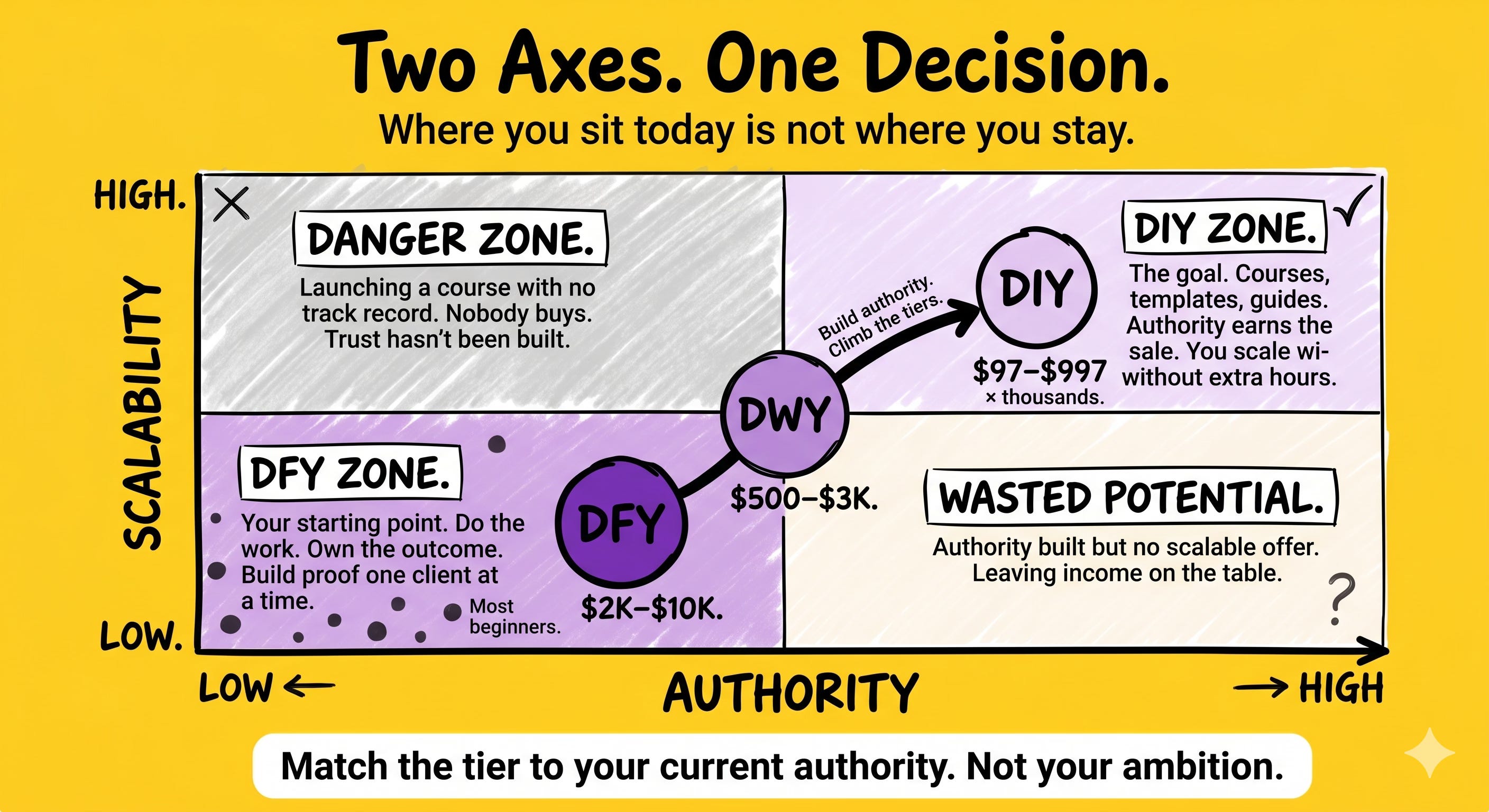
The two axes that decide everything:
Axis 1: Authority. Do people already trust your process? Or are you still proving it?
Axis 2: Scalability. Do you need one high-ticket client this month, or thousands of low-ticket customers eventually?
Where those two answers intersect, that’s your tier.
Read each one. Figure out where you actually are. Then come back and pick your move.
TIER 1: DONE FOR YOU
The misunderstood starting point.
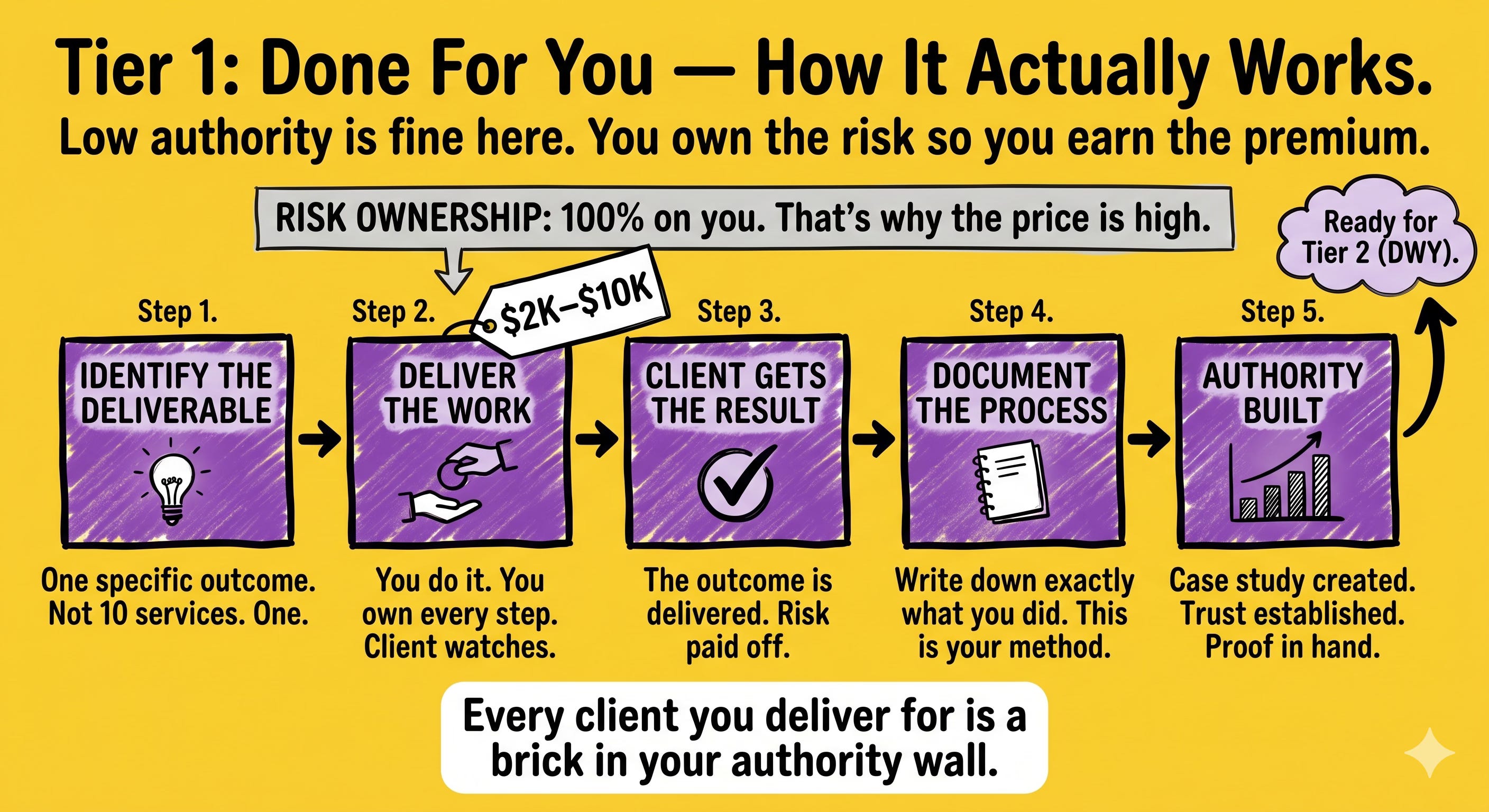
Most people think DFY is for agencies. It’s not. DFY is the tier where you do the work, own the outcome, and price accordingly. No course. No templates. No “follow my system.” You just deliver.
The reason DFY works when your authority is low is one word: risk.
When you have 200 subscribers and no track record, asking someone to buy your course is asking them to trust an unproven system with their own time. That’s a hard sell. But offering to do the work yourself? The risk is yours now. If it goes wrong, you fix it. The buyer doesn’t need to trust your method because you’re carrying the execution.
That shifts the entire sale.
Here’s the honest tradeoff. DFY is not scalable. You trade time for money one client at a time. The ceiling is your calendar. And the price has to reflect that. $2,000 to $10,000 per engagement is the realistic range for a solo operator. You’re not selling information. You’re selling a guaranteed outcome.
Who DFY is for right now:
If you have under 500 subscribers and haven’t sold anything yet, start here. Not because it’s easy. Because it’s honest. It lets you build proof while you build authority. Every client you deliver for becomes a case study. Every case study is a brick in the authority wall.
Do not stay here forever. DFY is the starting position, not the finish line.
Step 1. Name the one deliverable you can execute better than most people. Not 10 services. One thing. The clearer the deliverable, the easier the sale.
Step 2. Price it at what the result is worth, not what feels comfortable. Charging $200 for $2,000 of work is a mistake. You’re removing their risk. Price accordingly.
Step 3. Deliver. Document every step of your process. That documentation becomes your framework. This is how Tier 1 feeds everything above it.
TIER 2: DONE WITH YOU
The tier most creators skip past too fast.
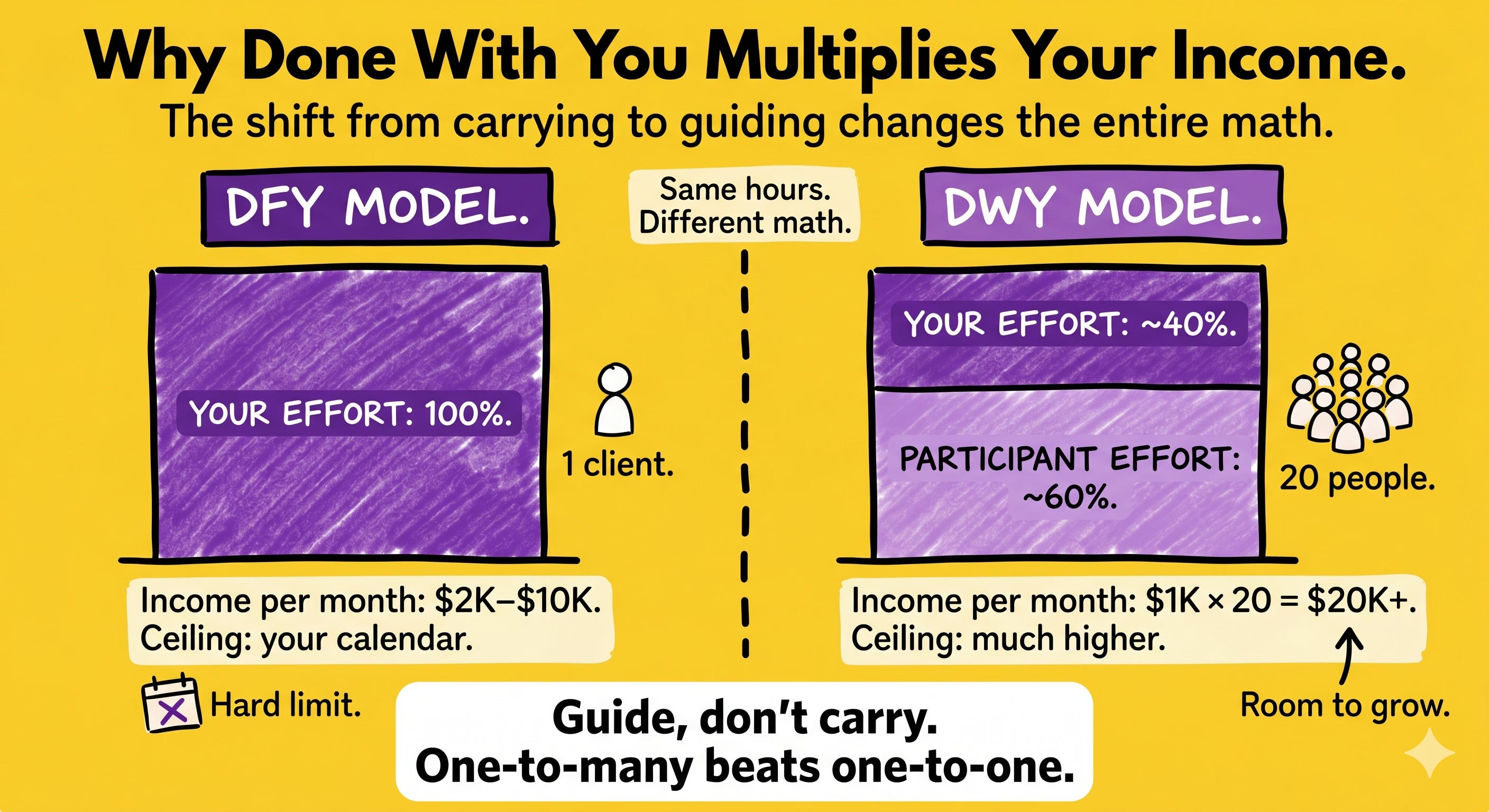
DWY means you show up alongside the client. They do the work. You provide the map, the feedback, the course corrections. You’re a guide, not a delivery machine.
This tier needs more authority than DFY. When you do the work for them, you own the result. When you do it with them, they need to believe your guidance is worth following. They’re putting in hours based on your system. That trust has to already exist before they sign up.
The business model changes here too. DWY typically runs as group programs, cohorts, or coaching retainers. Usually $500 to $3,000 per person. You can run 10 to 30 people at once, which means income starts compounding without your calendar multiplying at the same rate.
The scalability ceiling is higher than DFY. Lower than DIY. That’s intentional. DWY is where you validate your method while still being in the room. If your process doesn’t work when you’re there to guide it, it won’t work when you’re not.
This tier has one underrated advantage. The client does the work, which means they build the skill. They get the result because they applied the method, not because you applied it for them. That case study is more compelling when the buyer is selling a DIY product later. “I taught them to do this themselves” is a stronger authority signal than “I did this for them.”
Who DWY is for right now:
You’re ready for DWY when you’ve completed DFY projects and your clients got results. You’ve proven the method exists. Now you guide others through it.
Step 1. Package your DFY process into a repeatable series of steps. This is your curriculum. It doesn’t need to be perfect. It needs to be learnable.
Step 2. Build a group container. Cohort. Monthly program. Live call series. The container makes it high-touch without making it purely one-on-one.
Step 3. Recruit your first cohort from your existing audience. The people who watched your DFY work are the warmest buyers for a DWY program. Start there.
TIER 3: DO IT YOURSELF
The most coveted tier. The hardest to access without the tiers before it.
DIY is a course. A template pack. A video series. Something someone buys and executes alone, without you in the room.
The upside is real. Sell once. Deliver to thousands. Your income is no longer capped by your hours. One course can make money at 3am while you’re asleep. That’s not a fantasy. That’s the math when the tier is built correctly.
The problem is the trust requirement is enormous.
When someone buys your course, they’re betting their time on your method. They’re going to spend hours following your steps, and the result depends almost entirely on your system being right. For them to take that bet, they need to already believe you know what you’re doing.
That belief doesn’t come from a good sales page. It comes from watching you prove it first.
This is why every creator selling $500 courses to thousands of people has one thing in common. They built authority in public first. They wrote 300 newsletters. They showed the results. They built the case studies. The course was just packaging what people already trusted.
If you launch a DIY product with 200 subscribers and no proof, you’re asking for a high-trust sale with a low-trust track record. The math doesn’t close.
But if you’ve spent a year doing DFY work, moved into DWY, and now have 2,000 to 5,000 people watching your process? That course sells. Because the authority is already there.
Who DIY is for right now:
You’re ready for DIY when your audience starts asking for it. Not when you feel ready. When they ask: “Is there a course for this?” That’s the signal.
Step 1. Pull out your DWY curriculum. It’s already 80% of the course. Package it for self-paced delivery.
Step 2. Record the steps, not the coaching sessions. The mistake is recording live calls and calling it a course. Distill the framework. Each video should be one thing the student does before moving to the next.
Step 3. Price based on transformation, not video hours. A 45-minute course that generates a clear result is worth more than a 10-hour library of information. Outcome is the value. Time is not.
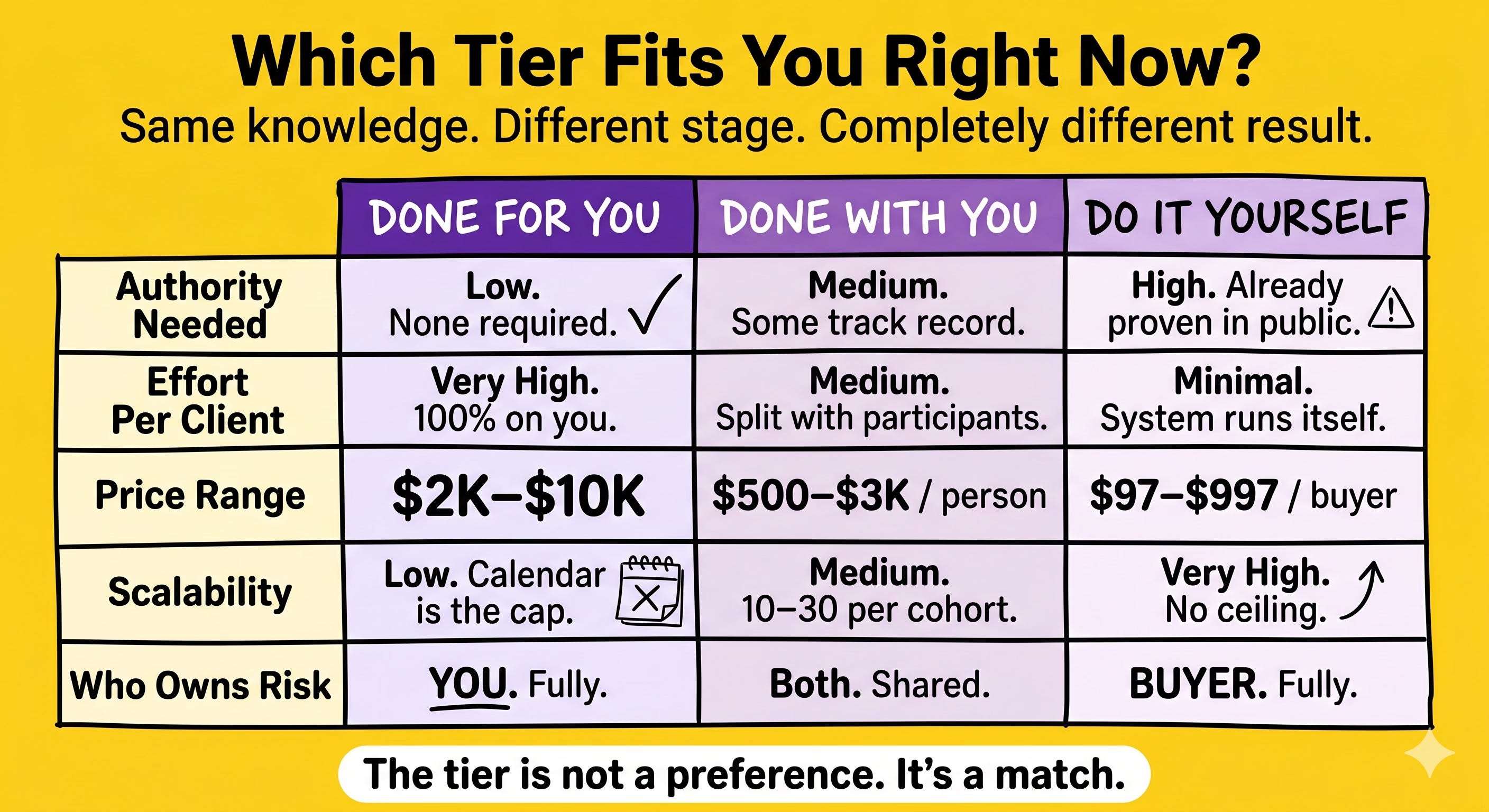
THE FULL TIERS PICTURE
Here is everything in one view.
DFYDWYDIYAuthority neededLowMediumHighEffort per clientVery highMediumMinimalScalabilityLowMediumVery highPrice per unit$2K–$10K$500–$3K$97–$997Who carries the riskYouBothBuyer
The move most people need to make isn’t building a better course. It’s starting at the right tier.
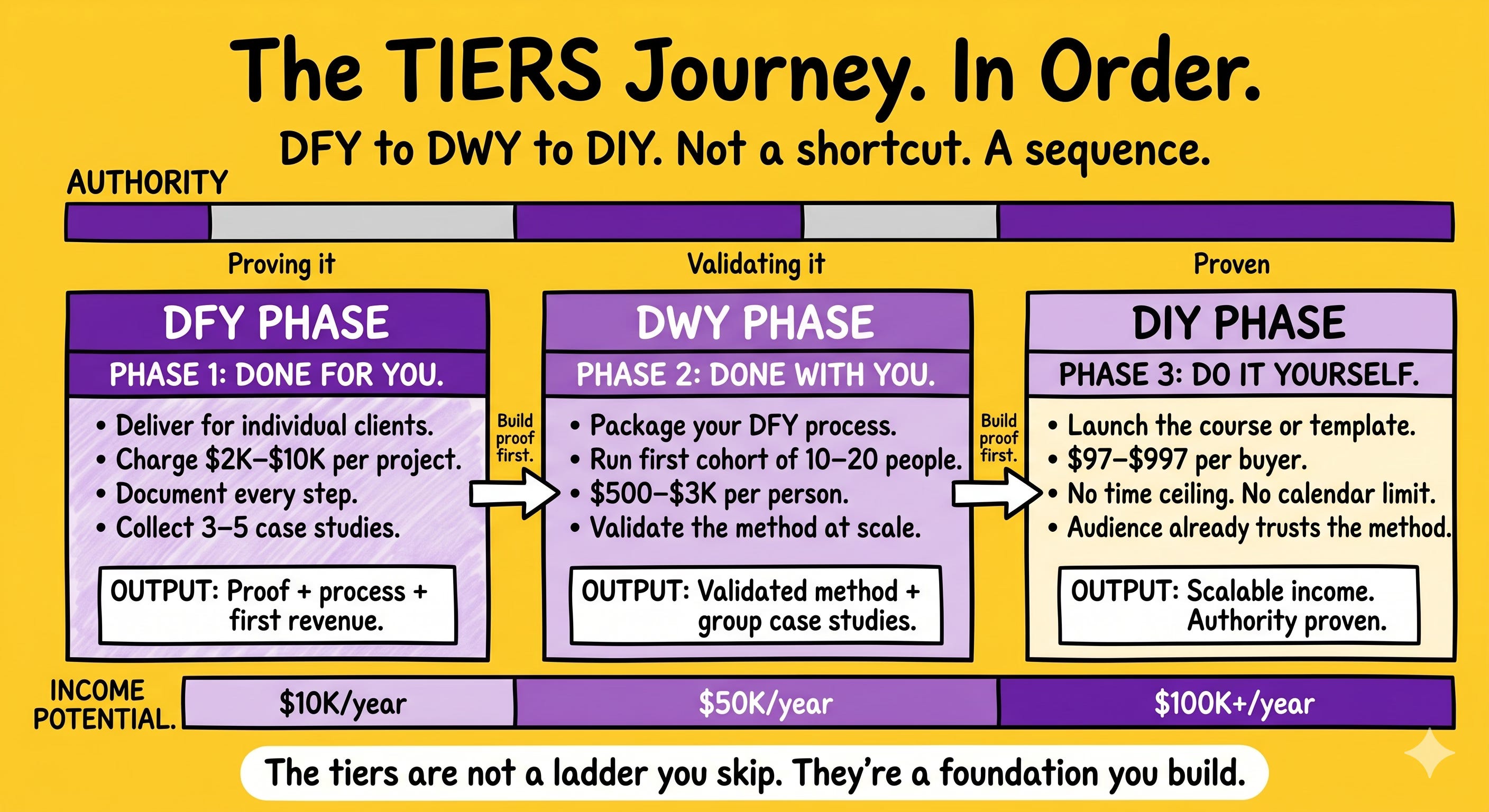
Start at DFY. Get results. Move to DWY. Validate the method. Build to DIY. Only then does the scalable income math work the way everyone promised.
The path is DFY to DWY to DIY. Not DIY first because someone on Twitter sold a course. Not a shortcut. A sequence.
THE TAKEAWAY
Your product isn’t the problem. Your tier is.
If your course isn’t selling, you’re probably asking people to trust a method you haven’t proven yet. That’s not a product problem. That’s a sequencing problem.
Start where your authority actually lives. Build proof at DFY. Validate at DWY. Only launch the DIY product when the market has already asked for it.
The creators making $10K a month from digital products didn’t skip the early tiers. They built through them. That’s the path. Not the shortcut.