

Your 9-5 Isn't the Problem. Staying There Is
5 stages from salary to freedom. Learn each one. Skip none

Most people who want to quit their 9-5 are solving the wrong problem.
They think the job is the problem.
It isn’t.
I spent 15 years in Big 4 consulting thinking the same thing. Counting down to Fridays. Telling myself the next promotion would fix it. Watching the same bank balance cycle through the same pattern every month.
The job wasn’t the problem. I didn’t have a map.
Nobody gave me one. Nobody gave you one either. We were all handed a plan that looked like this: get a degree, get a job, work hard, maybe get promoted, repeat until 65.
That’s not a wealth plan. That’s a waiting plan.
There is a real map. Nathan Barry, founder of Kit (formerly ConvertKit, a $20M+ software company), drew it. His path started at a Wendy’s drive-through at 15 years old. Mine started in a glass-walled meeting room on the 30th floor.
Same map. Different starting points.
The question isn’t how to escape the 9-5.
The question is which rung you’re on. And what the next one looks like.
By the end of this you will know exactly where you stand. And what one move to make next.
The Idea That Changed How I See Money
Making money is a skill.
Not luck. Not a personality type. Not something you either have or don’t.
A skill. Like any other. You get better at it by learning specific lessons at specific stages.
This is important. Read it again.
You wouldn’t sit down at a piano for the first time and expect to play a concert. But we expect to skip from a $60k salary to a $600k business in a year. Then we call ourselves failures when it doesn’t happen.
It doesn’t happen because we skipped stages.
Every person who built real wealth climbed the same ladder. Step by step. Stage by stage.
Each stage teaches something. Miss the lesson and the next stage punishes you for it. Pass the lesson and the next stage opens up.
The 9-5 is not your prison.
It’s Stage One.
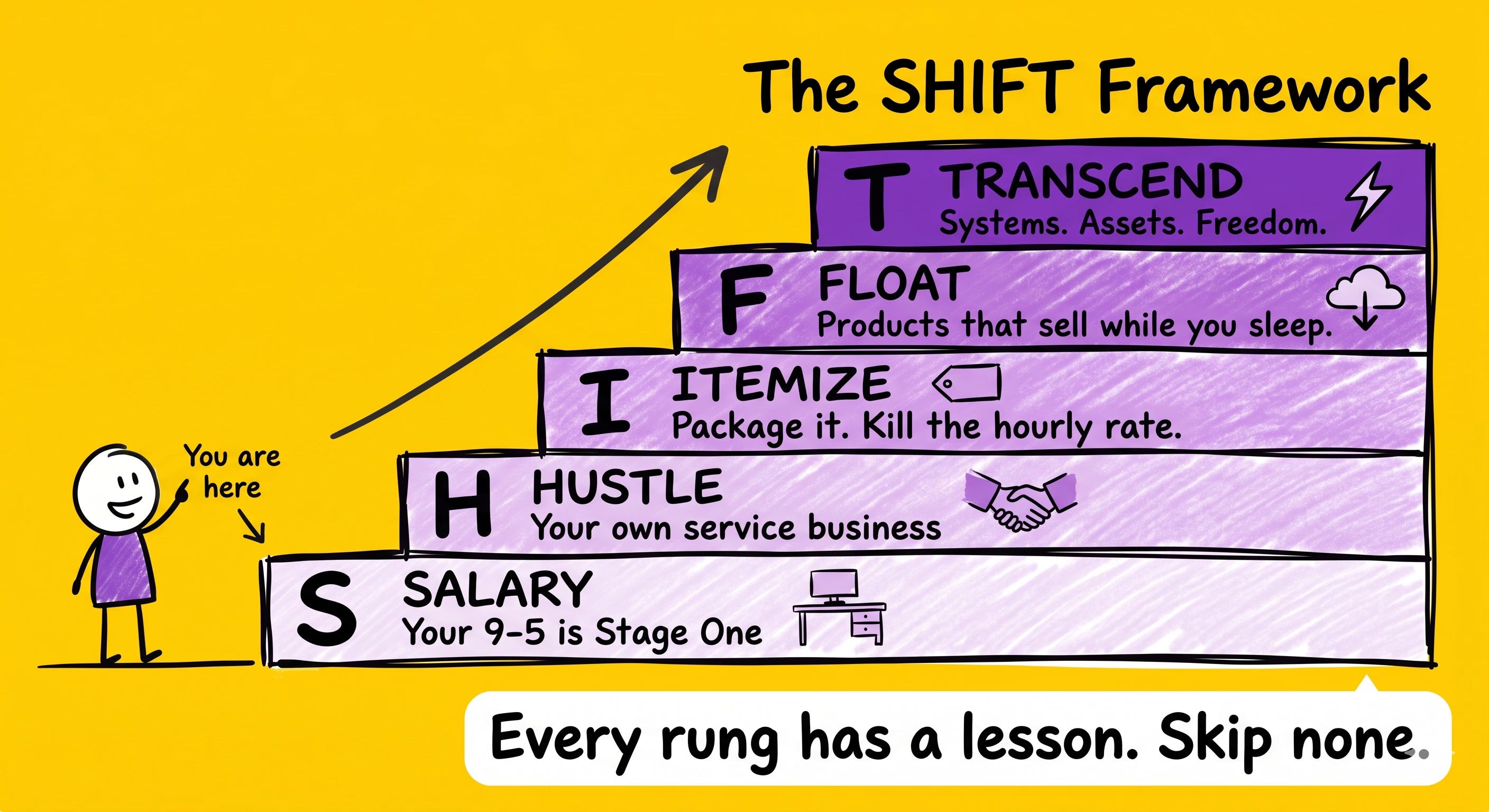
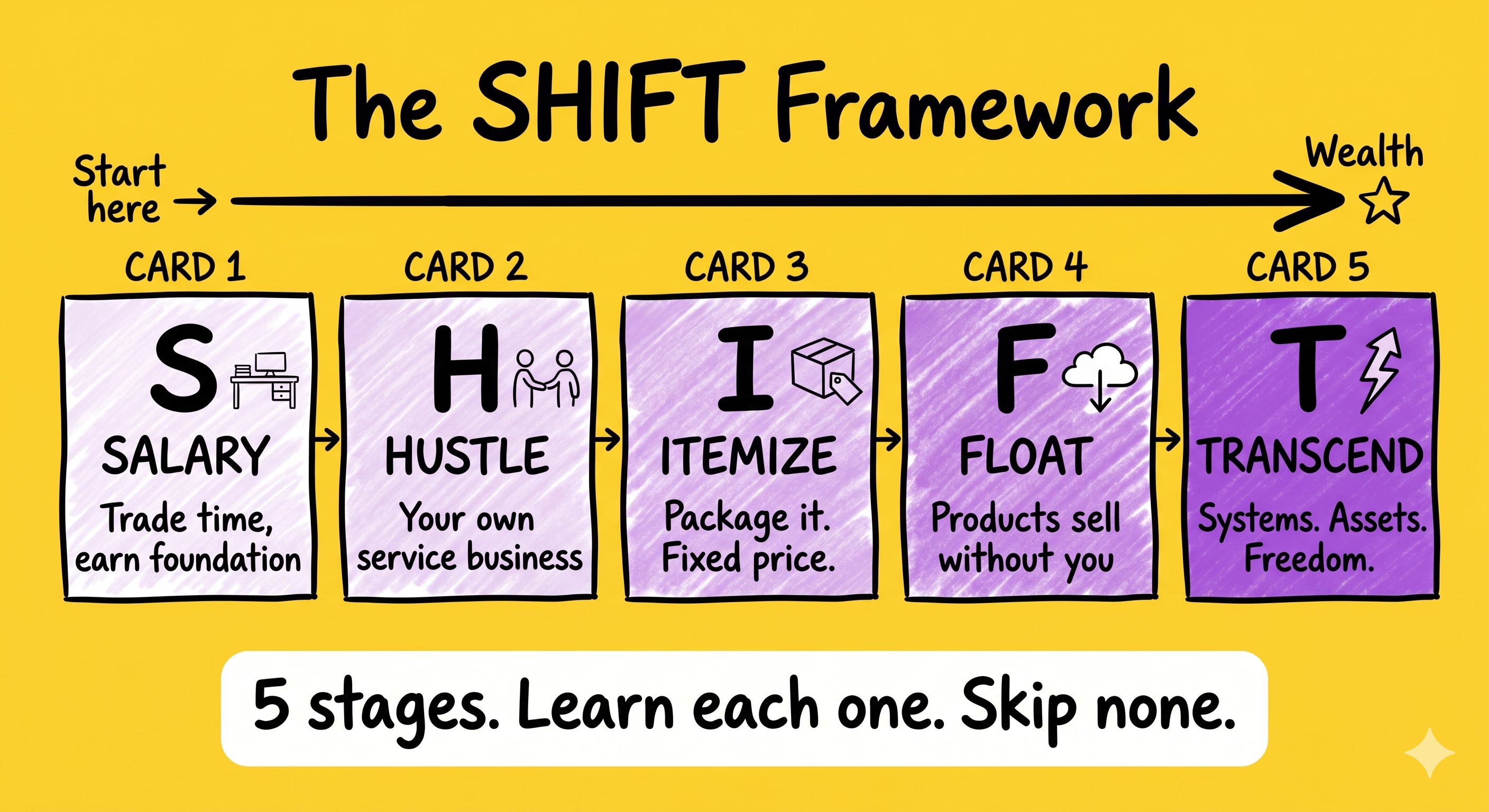
The SHIFT Framework: 5 Stages to Build Wealth
Here’s the map they never showed you.
S: Salary. Your 9-5 is where you begin. Not where you stay.
H: Hustle. Your own service business. You charge for your skills directly.
I: Itemize. Package your work. Kill the hourly rate. Sell outcomes, not time.
F: Float. Products that sell without you. Income while you sleep.
T: Transcend. Systems, recurring revenue, assets. This is where wealth compounds.
Each stage is harder than the last. Each stage pays more than the last.
You cannot skip ahead without paying for it later.
Let’s go through each one.
Stage S: Salary (Your 9-5 Is a School, Not a Sentence)
This is the hardest thing to accept.
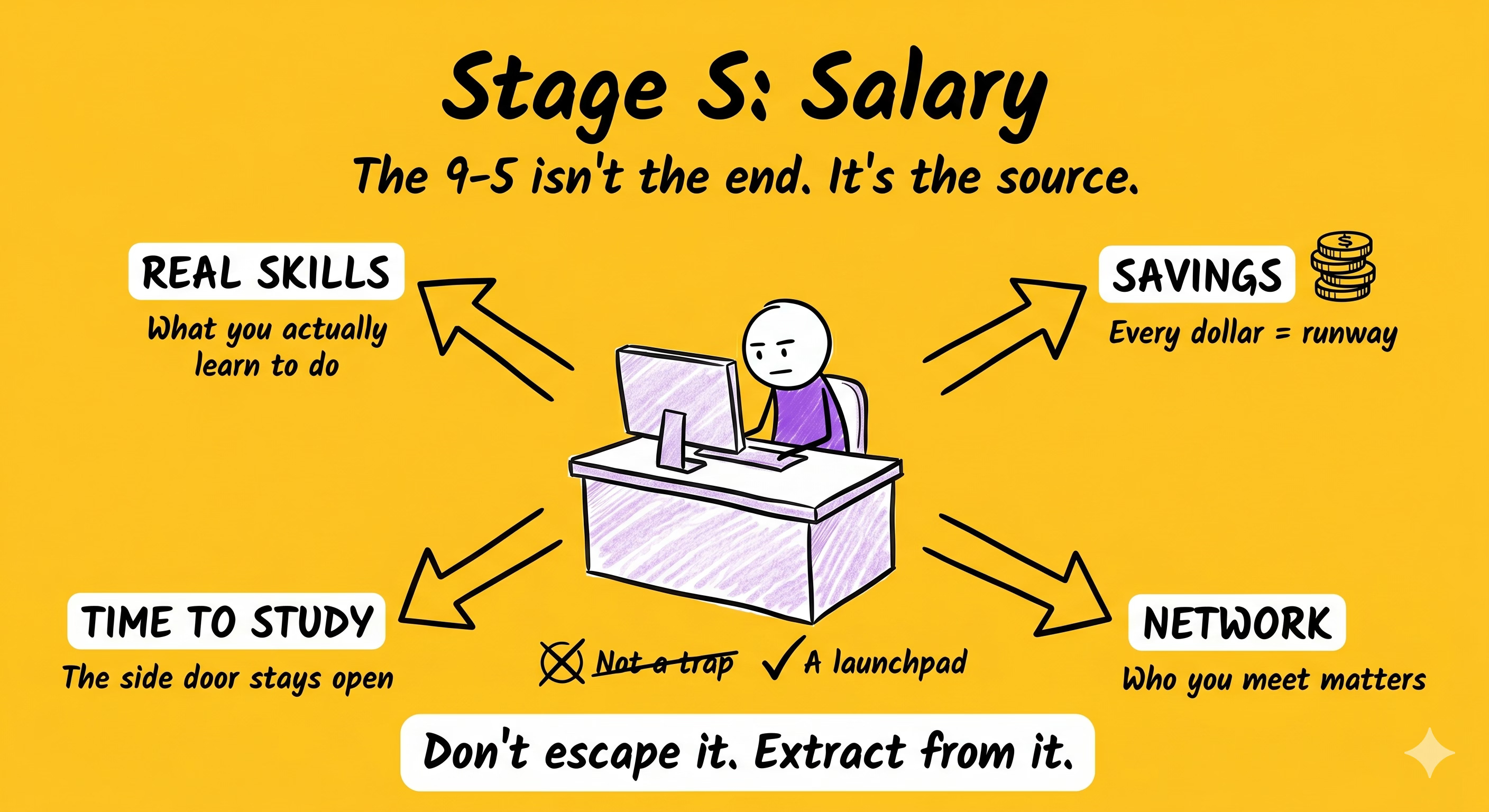
Your 9-5 is not a trap. It is the best starting point you have right now.
Read that without flinching.
Most people waste Stage S. They complain through it. They coast through it. They leave before they should and go straight to Stage H broke, with no savings, no skills, and no clients.
Then Stage H destroys them.
What the job is actually giving you
While you are at Stage S, three things are available to you that you cannot get anywhere else right now.
A paycheck. Runway. Money to fund the next stage.
Real skills. Even a job you hate is teaching you something. Communication. Systems. How organisations work. How decisions actually get made. These are not useless. They are the skills you will sell in Stage H.
Time. Not a lot. But some. Enough to start. Enough to study. Enough to plant seeds.
The mistake isn’t being at Stage S.
The mistake is treating Stage S like a destination.
The one rule that changes everything
Do not lifestyle inflate.
Every raise, every bonus, every overtime check. Give none of it to a car payment or a nicer apartment. Every extra dollar has one job. Fund the next stage.
Most people spend ten years at Stage S learning none of the lessons. They end up with a better salary, a more expensive lifestyle, and the same amount of freedom.
Nothing changed. It just costs more now.
How to know when you are done with Stage S
You are ready to move to Stage H when two things are true.
You have a real skill that someone outside your company would pay for.
You have savings to cover at least three months without income.
That’s it. That’s the exit sign.
Show up. Be reliable. Develop a real skill. Save everything you can. Study Stage H on the side.
Blow those lessons here and every other stage makes you pay twice.
Stage H: Hustle (Build Your Exit While You Still Have an Income)
Stage H is where you take the skills from Stage S and charge for them directly. You find your first client. You do the work. You learn what it actually takes to sell yourself.
Freelance design. Consulting. Copywriting. Coaching. Editing. Video. Social media management. Whatever you are genuinely good at.
Do not quit your job yet
That is the most common mistake people make. They quit before they’re ready. They need the income immediately. The pressure makes them take any client, at any price, doing work they don’t want to do.
That’s not freedom. That’s a different kind of trap.
You build Stage H on the side. While you still have the paycheck. While the rent is still covered. While you can afford to say no to bad clients.
Pressure makes bad decisions. A paycheck removes the pressure.
The number to hit before you move
Do not quit your 9-5 until your side income is twice your salary. Not equal. Twice.
That sounds extreme. It isn’t.
When you quit, your expenses do not stay the same. Taxes go up. Benefits disappear. Income becomes inconsistent. Months with no clients happen. Twice your salary is not ambition. It is a buffer.
Most people quit at equal. Then panic sets in at month three. Then they take any work at any price. Then they resent the business they built.
Twice. That is the number.
What Stage H is really teaching you
Stage H teaches lessons no job ever can.
How to find a client. How to write a proposal. How to price your work without apologising for it. How to handle the silence after you send a quote. How to follow up without sounding desperate. How to collect a payment from someone who is suddenly hard to reach.
Every one of those lessons is uncomfortable the first time.
That discomfort is the tuition.
This stage is messy. Most people quit here.
Most people do not build wealth.
The lesson at Stage H: learn to sell, learn to deliver, learn to handle the chaos of owning something. Stay until it’s time. Do not rush the exit.
Stage I: Itemize (Stop Selling Hours. Start Selling Outcomes.)
The hourly rate is a ceiling disguised as a floor
Here is what kills most freelancers.
They sell time.
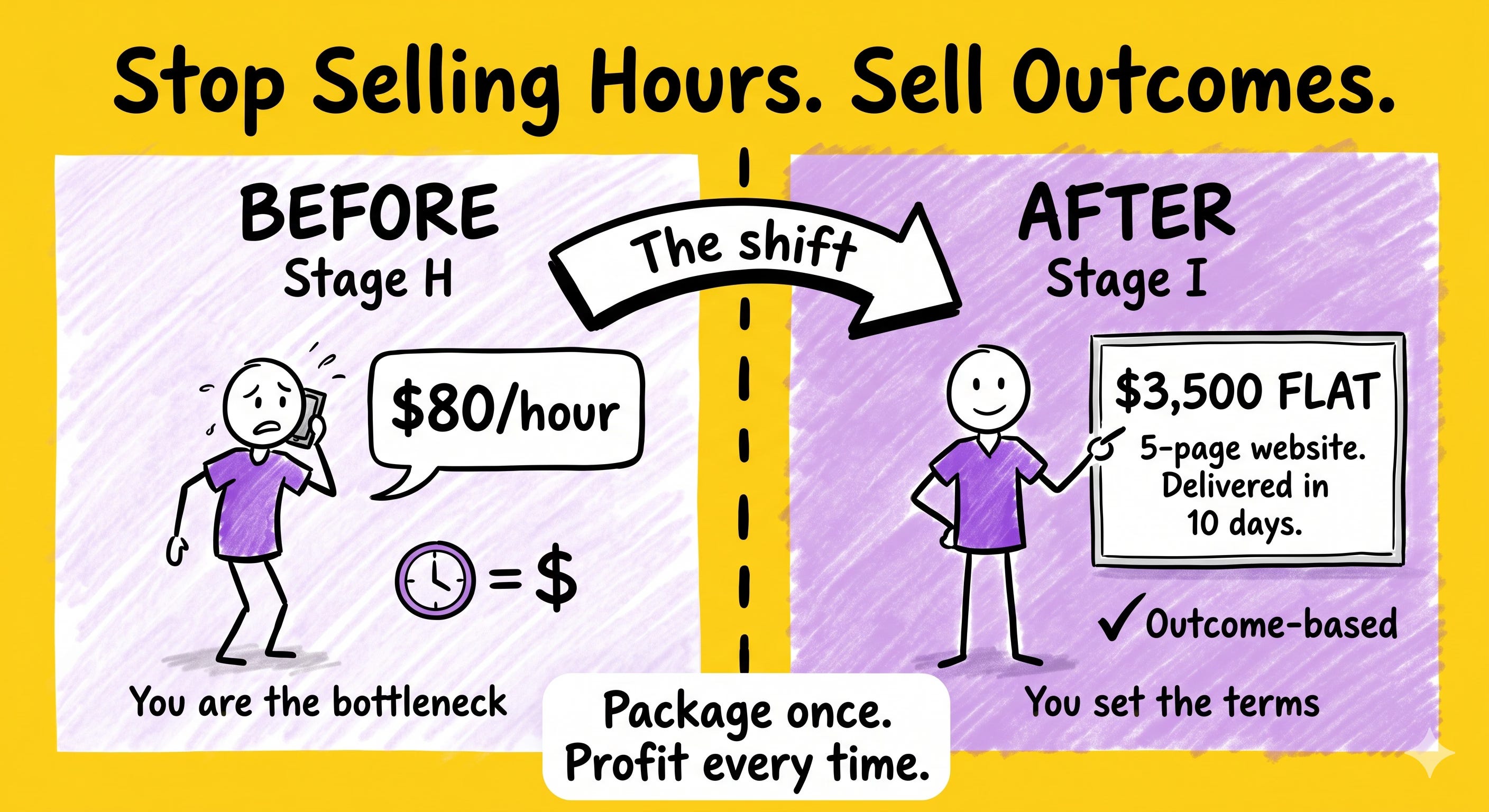
“I charge $80 per hour.” “This project will take about 12 hours.” “I’ll send you an invoice for the hours.”
The ceiling on that model is your hours. You have 24. You cannot sell 25. No matter how good you get, no matter how many clients you have.
You hit the wall. Then you work weekends. Then you burn out. Then you wonder why you left the 9-5.
Stage I is where you kill the hourly rate.
What packaging actually looks like
You take what you do and package it. Fixed price. Clear scope. Specific result.
A web designer stops charging $80 per hour and starts charging $3,500 for a 5-page site. A video editor stops charging $50 per hour and charges $800 per video. A consultant stops billing time and packages a 90-day strategy sprint for $6,000.
Two things happen immediately.
You make more on jobs where you are fast and efficient. You stop losing money when you’re slow.
The client also stops thinking about hours. They start thinking about the result. That is a very different conversation.
The real skill Stage I is building
This is the one most people miss.
You learn how to sell without talking to someone first.
A fixed-price package on a page can sell itself. An hourly rate always requires a call. Always requires negotiation. Always requires you.
Remove yourself from the equation. Make the offer clear enough that someone can say yes without your help.
That skill carries you all the way to Stage F. Start building it here.
The lesson at Stage I: your income should not depend entirely on how many hours you physically worked this week. Remove yourself from the sale.
Stage F: Float (Make Something Once. Sell It Forever.)
This is where it gets interesting.
Every stage before this required you to deliver every sale yourself. Even with a fixed package, someone still had to do the work. That someone was you.
Stage F removes that completely.
What changes at Stage F
You create something once. You sell it many times. You deliver it automatically. You are not in the loop.
An ebook. A video course. A template pack. A swipe file. A membership. A digital guide.
The work is in the creation. Once it exists, it exists. Someone can buy it at 2am on a Tuesday while you are asleep. You wake up to a payment notification. You did nothing last night.
That is not passive income as a buzzword.
That is what happens when a product replaces a service.
The 2am test
Here is a simple test for whether you have reached Stage F.
Can someone give you money at 2am without you being awake or involved?
If yes, you have a product.
If no, you still have a service.
Most people think they have a product. They have a service with a fancy name. There is a difference. The difference is whether a sale happens without you.
Why audience is non-negotiable here
Stage F requires skills that Stage H and Stage I did not prepare you for.
Writing sales copy that converts without you in the room. Driving consistent traffic to a page. Building trust with strangers who have never met you.
This is where building an audience changes everything.
Every stage is easier with an audience. Stage F is nearly impossible without one.
An audience is not a follower count. A follower count is vanity. An audience is people who trust your perspective enough to pay for it without a sales call.
Start building yours at Stage S. A newsletter. A LinkedIn post. A short thread. Something that shows people how you think. Grow it quietly through Stages H and I. By Stage F, that audience will be the most valuable thing you own.
The lesson at Stage F: one product can pay you forever. Build it once. Sell it always. Stop trading every dollar for your time.
Stage T: Transcend (Where Wealth Actually Compounds)
This is the stage everyone posts about.
Very few reach it. Most of those who do needed 5 to 10 years of Stages S through F to get here.
What Stage T actually looks like
Stage T is when your income is not tied to your hours at all.
Software. Recurring subscriptions. Real estate cash flow. Investment returns. Things that earn without your daily involvement.
You are not working less. You are working on things that pay you beyond the hours you put in. That is a different thing entirely.
Nathan Barry built ConvertKit to $18M+ per year in recurring revenue. Before that, he earned $250,000 selling ebooks in 2013.
Then his income almost disappeared for five years while he built the software.
Five years.
The drop nobody talks about
That part does not appear in the success posts. Nobody puts the five-year valley in the caption.
Moving between stages often means a drop in income. Sometimes for months. Sometimes, like Nathan, for years. That is not a sign you are failing.
That is the cost of admission to the next level.
Most people see the drop and go back. They return to Stage H or Stage I. Safe. Familiar. Capped.
The people who reach Stage T are not smarter than you. Not luckier. They just refused to turn around during the drop.
The one rule every Stage T person lives by
You do not get here by spending every extra dollar on lifestyle.
Every person who built real wealth had one rule that stayed consistent: reinvest in assets, not things.
An asset pays you. A thing costs you. A depreciating gadget, a car upgrade, a weekend break you put on credit. Those are not rewards. They are delays.
The compounding starts the moment you stop choosing things over assets.
The lesson at Stage T: the drop between stages is normal. The reinvestment discipline is everything. Stop building lifestyle. Start building assets.
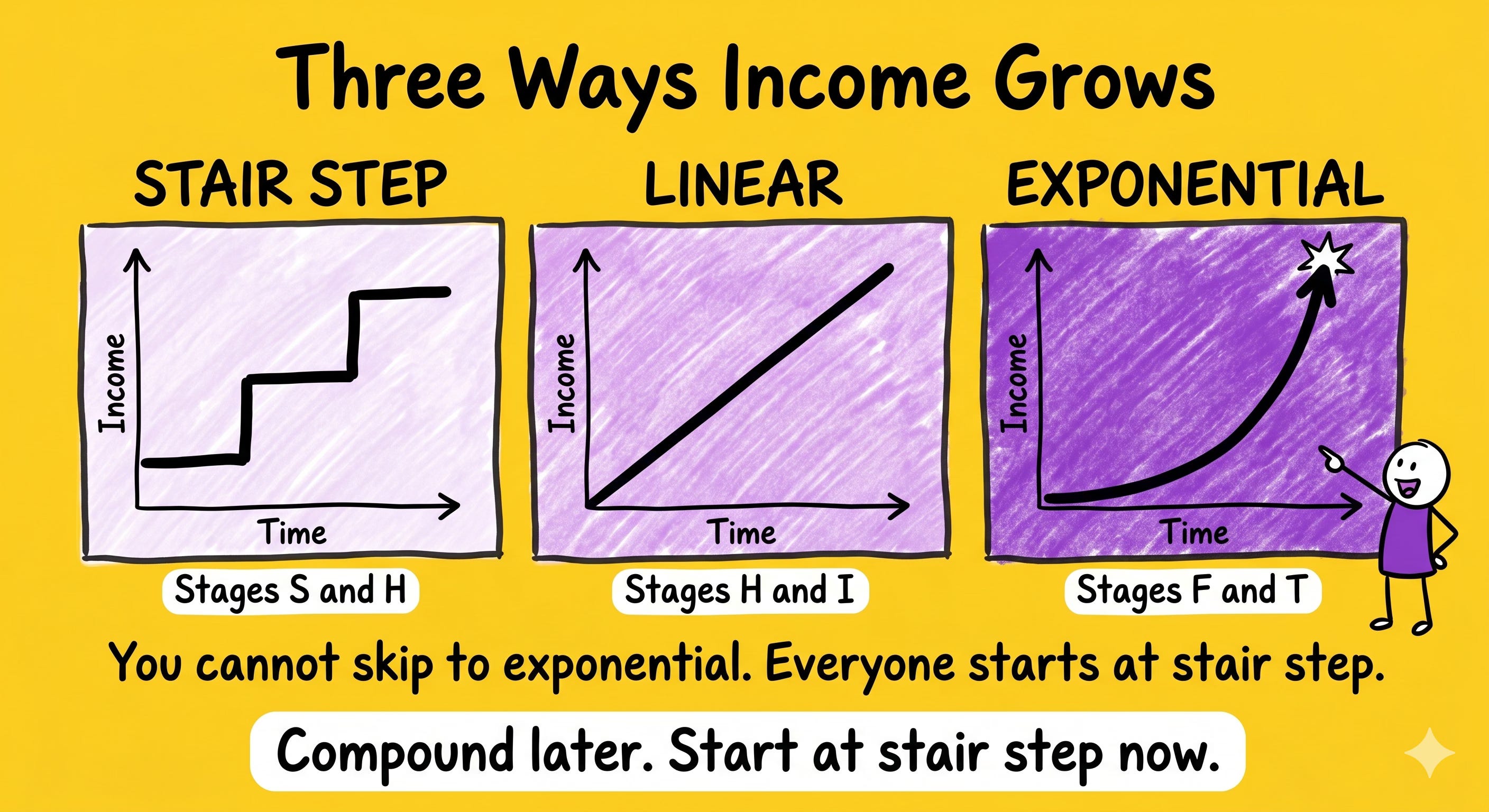
The Three Income Curves (And Why Most People Are Trapped on the Worst One)
There are three ways income grows. Only three.
Stair step. Get a raise. Get a promotion. Switch to a better job. Your income jumps, then holds flat until the next jump. This is Stage S and early Stage H. Reliable. Manageable. Capped.
Linear. Consistent effort equals consistent growth. A freelancer steadily increasing rates. A creator posting consistently month after month. Growth happens. But it scales with your output. When you stop, it slows.
Exponential. One sale makes the next sale more likely. Products compound. Audience compounds. Revenue grows faster than your hours. The ceiling disappears.
This is what Stage F and Stage T produce.
Here is the part that breaks people.
Exponential income starts as the slowest of the three. Months, sometimes years, of almost nothing. The stair step feels faster. The linear feels safer. Most people give up on exponential before the compounding kicks in.
They quit at the hardest part.
You cannot skip to exponential. Every person with exponential income started at stair step. Every one.
The goal is not to skip stages. The goal is to graduate from each one fast enough to reach the one where things compound.
The Stage That Kills the Most Dreams
You know which stage wrecks the most people?
Not Stage S. Stage S is fine. The system trains people to survive Stage S.
The killer is Stage H to Stage I.
Most people who leave their 9-5 get stuck in Stage H forever. They hustle. They work harder than they ever did in the office. They burn through clients. They chase the next one. Years pass.
They never packaged anything. Never productised. Never stopped selling hours.
They built a job without the benefits. Worse job. More stress. Still no freedom.
The shift from H to I is a mindset shift before it is a business shift. You have to stop thinking like someone who got a different employer. You have to start thinking like someone building something that exists without you in the room.
That is uncomfortable. It feels like starting over.
It is not. It is graduating.
Where You Are Right Now
Before you close this, answer one question honestly.
Which stage are you on?
Not which stage you want to be on. Which one are you actually on today.
Stage S. You have a 9-5. You are still in it. That is not failure. That is your foundation. Your one job right now is to not lifestyle inflate and to study Stage H on the side.
Stage H. You have clients. You are billing hours. You feel the ceiling closing in. Your one move is to write one fixed-price offer. One package. One outcome. Test it this month.
Stage I. You have packages. You have some consistency. Your next move is to ask what part of this can exist without you in every conversation. What can go on a page and sell itself.
Stage F. You have a product. It sells, but slowly. Your one job is the audience. Build it. Feed it. Make it trust you.
Stage T. You are here or close. You know what you are doing. Stay patient. Keep reinvesting. The compounding hasn’t stopped.
One stage at a time.
The 9-5 is not your prison.
It is where you build the runway to leave properly.
Start there. Learn there. Fund the next stage from there.
Most people spend their whole career waiting for permission to move.
You just got the map.